

The Complete Guide to BANT Sales Methodology for B2B SaaS
BANT is a lead qualification framework developed by IBM, designed to help sales professionals determine if a prospect is a good fit.
In the competitive landscape of B2B SaaS, sales success hinges on one critical factor: efficiently qualifying leads. Spending valuable time and resources on prospects who are unlikely to convert is a costly mistake. This is where the BANT sales methodology comes in. At GTM Playroom, we believe that understanding and mastering BANT is not just a sales skill, but a fundamental strategy for sustained growth in the SaaS sector.
This comprehensive guide will demystify BANT, showing you how this powerful framework can transform your sales process, shorten sales cycles, and significantly boost your win rates. Whether you are a sales leader looking to optimise your team’s performance, an aspiring sales professional aiming to master essential skills, or a funded SaaS company seeking qualified talent, this is your definitive resource.
The Foundation of Smart Sales Qualification
What is BANT? A Clear Definition
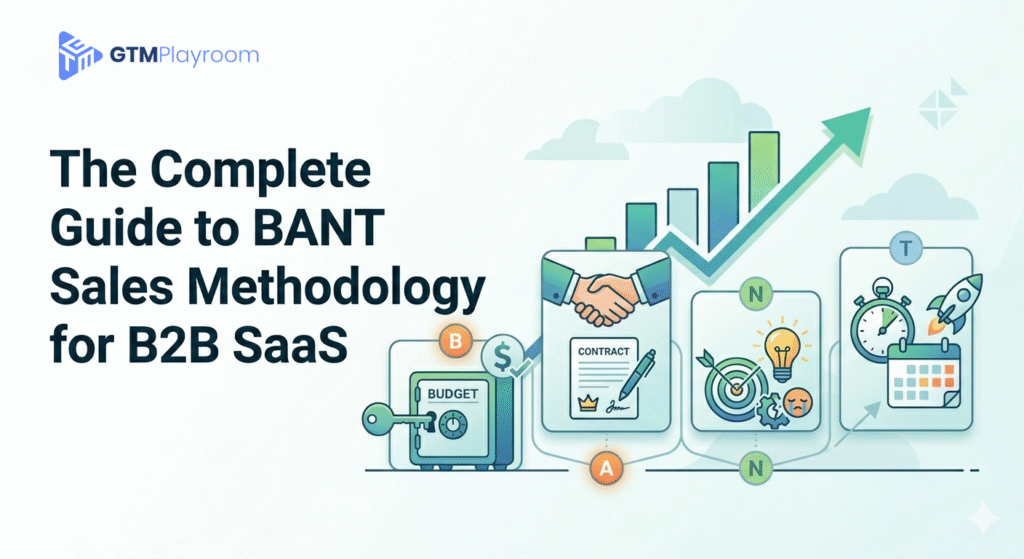
BANT is a lead qualification framework developed by IBM, designed to help sales professionals determine if a prospect is a good fit. It stands for four crucial elements:
- Budget: Does the prospect have the financial capacity or a clear understanding of the investment required for your solution?
- Authority: Is the prospect a decision-maker or an influencer who can lead you to the ultimate authority?
- Need: Does the prospect have a genuine problem or challenge that your SaaS solution can effectively solve?
- Timing: What is the prospect’s timeline for implementing a solution? Is there an urgency to their need?
Why is BANT Crucial for B2B SaaS Sales?
In the fast-paced SaaS world, every interaction counts. BANT is not about rigid checkboxes. It is about a structured approach to understand your prospect’s readiness. For B2B SaaS companies, BANT is crucial for:
- Efficiency: Focus sales efforts on prospects with a higher likelihood of conversion, reducing wasted time on unqualified leads.
- Shorter Sales Cycles: By identifying key qualification points early, you can streamline the sales process and accelerate deals.
- Improved Forecast Accuracy: Better qualified leads lead to more predictable sales pipelines and revenue forecasts.
- Higher Win Rates: When you are selling to prospects who genuinely need your solution, have the budget, the authority, and a clear timeline, your chances of closing dramatically increase.
- Better Resource Allocation: Sales and marketing teams can align their efforts more effectively, directing resources towards high-potential opportunities.
A Brief History: Where BANT Came From
The BANT framework emerged from IBM in the 1960s as a way for their sales teams to systematically qualify leads. While decades old, its core principles remain remarkably relevant today, especially with the complexities of B2B SaaS sales involving multiple stakeholders and recurring revenue models. It provides a timeless foundation that has been adapted and refined for the modern digital sales landscape.
Deep Dive into Each BANT Component
Let us break down each element of BANT and explore how to effectively uncover the necessary information without being pushy or intrusive.
Budget: Uncovering Financial Readiness and ROI
Budget is often the most sensitive part of the BANT framework, but it is crucial. It is not just about “do they have money?” but “do they have money allocated, or can they get it, for a solution like ours?”
How to Uncover Budget Information Without Being Pushy
- Value-Based Approach: Shift the conversation from cost to value. Discuss the ROI your SaaS solution can deliver. “Based on similar clients, our solution typically helps reduce operational costs by X% or increase revenue by Y%. Does that align with the kind of impact you are looking for?”
- Tiered Pricing Discussions: Instead of asking “What’s your budget?”, present your typical pricing tiers or packages early in the conversation to gauge their reaction and open a dialogue.
- Budget Ranges: Ask about a general range rather than an exact figure. “Are you looking at an investment in the X to Y range for a solution like this?”
- Indirect Questions: “What initiatives are currently being prioritised for investment?” or “How do you typically fund new software implementations?”
Questions to Ask
- “What kind of investment are you anticipating for a solution that addresses [their stated need]?”
- “Have you allocated a budget for this type of project this fiscal year?”
- “How does your organisation typically approve technology investments of this scale?”
- “What impact would this have on your bottom line? What is that worth to you?”
Handling “No Budget” Situations
- Identify the Real Constraint: Is it truly no budget, or no priority for this budget?
- Future Planning: “When do budget cycles typically open up for initiatives like this?”
- Small Wins and Pilot Programs: Can you offer a smaller, lower-cost entry point that can prove ROI and build a case for future investment?
- Internal Champion Building: Help them build a business case internally to secure budget.
- Walk Away Strategically: Sometimes a lead truly has no budget and no path to getting one. Knowing when to disengage allows you to focus on more qualified prospects.
Connecting Budget to ROI in SaaS
- Quantify the pain: “How much is [their problem] costing you in terms of lost productivity, revenue, or customer churn?”
- Quantify the gain: “Our solution helps you save, earn, or optimise X. Over a year, that translates to Y.”
- Demonstrate the value: Use case studies, testimonials, and data to illustrate the tangible benefits that justify the investment.
Authority: Identifying Decision-Makers vs. Influencers
In B2B SaaS, deals are rarely made by a single person. Understanding who holds the purse strings, who makes the ultimate decision, and who influences it is paramount.
Decision-Makers vs. Influencers: Know the Difference
- Decision-Maker: The individual with the power to sign off on the purchase and allocate resources.
- Influencer or Champion: Someone who will use the product, benefit from it, or advocate for it internally. They can be critical but cannot make the final purchase.
- Blocker or Detractor: Individuals who might resist the change or see your solution as a threat. Identify and address their concerns early.
Strategies for Multi-Stakeholder Deals
- Organisational Chart Mapping: Ask about the team structure, who else would be involved in this decision, and what their roles are.
- Value Proposition Tailoring: Customise your message to resonate with each stakeholder. IT cares about integration, Finance cares about ROI, and end-users care about usability.
- Consensus Building: Help your champion gather internal buy-in by providing them with the necessary information and tools.
- Engage Key Stakeholders Early: Try to get all relevant decision-makers and influencers involved at appropriate stages.
Navigating Organisational Hierarchies
- Referral Up or Across: Ask your initial contact, “Who else in the organisation would be impacted by or need to approve a solution like this?”
- Connect with Power: Politely ask for introductions to higher-level executives if your initial contact is not the ultimate decision-maker.
- Understand Internal Processes: Ask about their company’s typical procurement and approval process for new software.
Need: Discovering True Pain Points and Challenges
The “Need” component is where you confirm that your SaaS solution is genuinely relevant. It is about understanding the prospect’s underlying problems, not just surface-level desires.
How to Discover True Pain Points
- Active Listening: Pay close attention to what the prospect says and does not say.
- Empathy: Understand their world, their daily frustrations, and their strategic objectives.
- Do Not Assume: Even if they mention a problem your software solves, dig deeper to understand the impact of that problem. “How does that affect your team, revenue, or customers?”
Effective Discovery Questions
- “What are the biggest challenges you are currently facing with [area your SaaS addresses]?”
- “If you could wave a magic wand, what is one problem you would want to solve immediately in [relevant department or process]?”
- “What happens if this problem is not addressed? What is the cost of inaction?”
- “How are you currently trying to solve this problem, and what are the limitations of that approach?”
- “What are your top three strategic priorities for the next 12 months, and how does this problem relate to them?”
Linking Your SaaS Solution Directly to Their Needs
- Problem-Solution Fit: Clearly articulate how your specific features address their specific pain points. Use their language.
- Quantify the Benefits: Show how your solution leads to measurable improvements. “Our platform reduces data entry time by 50%, freeing up your team for more strategic work.”
- Tailored Demos: Customise your product demonstration to highlight features most relevant to their stated needs.
Understanding Urgency of Need
- “How critical is it for you to solve this problem now versus in 6 months?”
- “What external factors are driving the need for a change?”
- “Are there any upcoming deadlines or events that make this a pressing issue?”
Timing: Assessing the Prospect’s Timeline for Implementation
Timing is crucial for forecasting and pipeline management. A prospect with a clear need and budget but no immediate timeline might be a long-term nurture, not a current sales opportunity.
Questions to Uncover Timeline
- “What is your ideal timeline for implementing a new solution like ours?”
- “Are there any upcoming projects, budget cycles, or business initiatives that this solution needs to align with?”
- “How long have similar technology implementations taken in your organisation?”
Identifying Catalysts for Change
- A new competitor entering the market
- An expiring contract with a current vendor
- A new strategic initiative or company goal
- A significant increase in pain points such as rapid growth or unexpected customer churn
- Budget availability or end-of-year spending
Aligning Your Sales Cycle with Their Timeline
- If their timeline is short and your sales cycle is long, identify potential bottlenecks and discuss acceleration options.
- If their timeline is distant, agree on next steps for nurturing the relationship until they are ready.
- Proactively communicate your implementation process and typical onboarding timeframes to manage expectations.
Implementing BANT Sales Methodology in Your Process
BANT is not just a checklist. It is a dynamic framework that should be integrated seamlessly into every stage of your sales process.
Integrating BANT into Your CRM
- Custom Fields: Create custom fields in your CRM for BANT data points. This allows for standardised tracking across your team.
- Stage-Gate Qualification: Set up sales process stages that require specific BANT criteria to be met before a deal can advance. For instance, a lead cannot move from Discovery to Proposal until Budget and Authority are reasonably clear.
- Reporting and Dashboards: Build reports to visualise BANT completeness across your pipeline. This helps sales managers identify unqualified deals early.
- Automation: Use CRM automation to trigger tasks or alerts when certain BANT criteria are met or not met.
Training Sales Teams on BANT
- Role-Playing: Conduct regular role-playing exercises to practice BANT questions and objection handling.
- Call Reviews: Review recorded sales calls to provide feedback on how well BANT was applied.
- Continuous Learning: BANT is not a one-time training. Integrate it into ongoing coaching sessions. At GTM Playroom, we place pre-assessed sales talent who come ready to apply frameworks like BANT from day one.
- Customisation: Train your team on how to adapt BANT questions to different industries, company sizes, and specific SaaS offerings.
BANT Across Different Sales Stages
- Prospecting and Lead Generation: Use BANT as a preliminary filter. Marketing qualified leads should ideally have some BANT indicators before being passed to SDRs.
- Discovery Calls: This is the primary stage for BANT qualification. Ask detailed questions to uncover all four elements.
- Demo and Presentation: Tailor your demo to highlight how your solution addresses the specific needs identified. Confirm Authority and Timeline, and re-verify Budget if necessary.
- Negotiation and Closing: By this stage, BANT should be fully qualified. Any lingering doubts about Budget, Authority, Need, or Timing could derail the deal.
Beyond BANT: Comparisons and Evolution
While foundational, BANT is not the only sales qualification framework. Understanding its place in the broader sales methodology landscape is crucial for modern sales professionals.
BANT vs. MEDDIC: Which Framework is Right for Your SaaS?
MEDDIC (Metrics, Economic Buyer, Decision Criteria, Decision Process, Identify Pain, Champion) is often favoured for complex, enterprise-level SaaS sales due to its emphasis on measurable outcomes, the economic buyer, and internal decision processes.
- Complexity: MEDDIC is generally more complex and requires more in-depth discovery. BANT is simpler and can be applied earlier in the sales cycle.
- Focus: BANT focuses on basic qualification. MEDDIC drills down into how decisions are made, who makes them financially, and what measurable impact the solution will have.
- Best Use Cases: BANT is excellent for high-volume sales, SDRs, and initial qualification. MEDDIC excels in strategic, higher-value deals where a deep understanding of the customer’s internal workings is essential.
Other Qualification Frameworks Worth Knowing
- GPCTBA/C&I (Goals, Plans, Challenges, Timeline, Budget, Authority, Consequences and Implications): HubSpot’s evolution of BANT, adding more strategic elements.
- CHAMP (Challenges, Authority, Money, Prioritisation): Similar to BANT but emphasises challenges and prioritisation more explicitly.
- ANUM (Authority, Need, Urgency, Money): A streamlined version, often used for speed.
- FAINT (Funds, Authority, Interest, Need, Timeline): Another variation emphasising interest and adding more nuance.
How BANT is Evolving in the Age of Digital Sales and AI
- Data-Driven BANT: AI and sales intelligence platforms can now provide insights into a prospect’s budget, tech stack, and organisational structure before the first call.
- Hybrid Approach: BANT still serves as a strong conversational framework, but it is increasingly augmented by pre-call research and post-call data analysis.
- Buyer-Centric BANT: Modern BANT emphasises helping the buyer qualify themselves by understanding their needs and showing how your solution fits.
- Dynamic Qualification: The digital sales environment is fluid. BANT qualification is not a one-time event but an ongoing process throughout the buyer’s journey.
Common BANT Sales Methodology Mistakes to Avoid
Even with a clear framework, pitfalls exist. Avoiding these common mistakes will ensure your BANT implementation is effective.
- Over-reliance on Budget Without Understanding Nuances: Do not dismiss a lead simply because they do not have an immediate budget. They might have a future budget, or your value proposition could justify finding one. Focus on value first.
- Not Speaking to the Right Authority: Selling to an influencer is great, but they cannot close the deal. Always strive to identify and engage with the ultimate decision-makers.
- Assuming Needs Rather Than Discovering Them: Never presume you know a prospect’s pain points. Ask open-ended questions, listen actively, and let them articulate their challenges.
- Misjudging the Timeline: A prospect saying “soon” or “next quarter” can be vague. Dig deeper to understand concrete events or deadlines that drive their timeline. Otherwise, “soon” can become “never.”
- Treating BANT as a Checklist: BANT is a guide for conversation, not a rigid questionnaire. It should flow naturally within your sales dialogue.
- Failing to Adapt BANT: The nuances of BANT change depending on your product’s price point, target industry, and market maturity.
Measuring BANT Methodology Effectiveness
To ensure BANT is genuinely contributing to your sales success, you need to measure its impact.
KPIs to Track
- Conversion Rates: Track conversion rates at each stage of your sales funnel, especially from BANT-qualified lead to closed-won.
- Sales Cycle Length: Compare the average sales cycle length for BANT-qualified leads versus unqualified or poorly qualified leads.
- Win Rates: Analyse the win rate for deals that were fully BANT-qualified compared to those that were not.
- Average Deal Size: Qualified leads often lead to higher average deal sizes because value is clearly established.
- Lead Quality Score: Develop a scoring system that incorporates BANT criteria to rank your leads.
- Quota Attainment: Ultimately, is BANT helping your team hit and exceed their sales targets?
Feedback Loops for Continuous Improvement
- Sales-Marketing Alignment: Regularly review BANT definitions and lead hand-off processes between sales and marketing.
- Post-Mortem Analysis: For both won and lost deals, analyse the BANT criteria. Where did you qualify well? Where were there gaps?
- Team Discussions: Encourage your sales team to share best practices and challenges related to BANT application.
- CRM Data Analysis: Leverage your CRM’s reporting capabilities to gain insights into BANT trends and identify areas for coaching.
Conclusion: Empowering Your Sales Success with BANT
The BANT sales methodology, though decades old, remains an indispensable tool for efficient and effective lead qualification in B2B SaaS. By systematically assessing a prospect’s Budget, Authority, Need, and Timing, you can focus your efforts on high-potential opportunities, streamline your sales cycle, and significantly improve your win rates.
At GTM Playroom, we help early-stage B2B tech founders build their 0-to-1 GTM motion and place pre-assessed sales talent with funded SaaS teams who need people ready to apply frameworks like BANT from day one.
Not Sure if Your GTM Motion is Ready to Qualify at This Level?
Before your team can effectively qualify prospects, you need clarity on where your own sales process, pipeline, and positioning stand. Take the GTM Health Check Up to get a personalised assessment and a clear action plan to fix the gaps that are costing you deals.
Related Articles


Want to Apply These Insights?
Book a 45-minute GTM diagnostic and get a clear roadmap for your next 30-60-90 days.