

How Companies Build GTM Playbooks That Scale
Fast growing SaaS companies often reach a point where growth becomes uneven.
What worked in the early days starts to break.
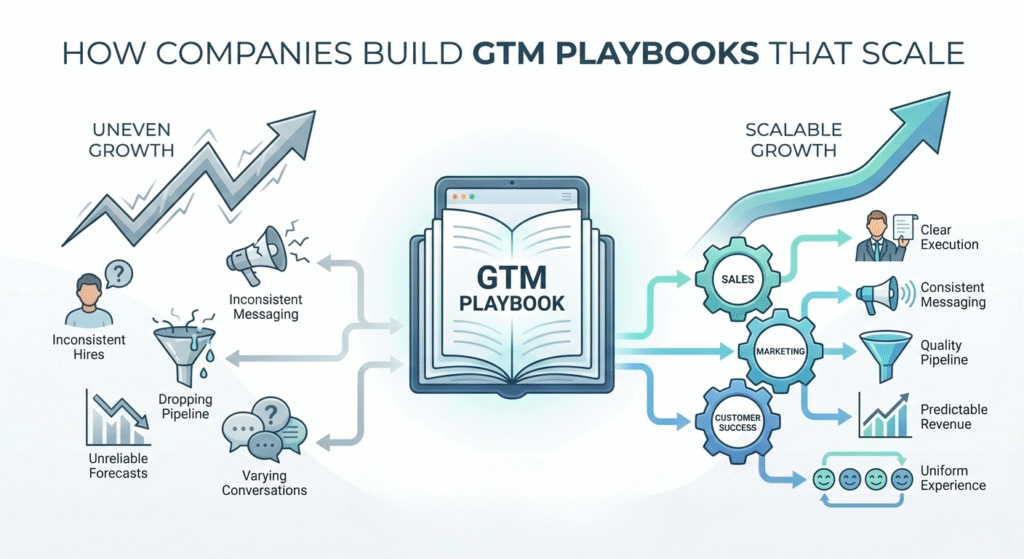
New hires perform very differently from each other.
Messaging sounds inconsistent across calls, emails, and demos.
Customer conversations vary depending on who is speaking.
At first, this feels manageable.
Then results start to slip.
Pipeline quality drops.
Close rates fluctuate.
Forecasts become unreliable.
When this happens, growth slows.
Predictability disappears.
Revenue becomes messy and difficult to control.
The solution is simple.
A strong GTM playbook.
Not a slide deck.
Not a theory document.
Not tribal knowledge stored in people’s heads.
A real system that teams can follow every day.
What a GTM Playbook Does
A GTM playbook turns strategy into a clear step by step operating system.
It takes high level thinking and translates it into daily execution.
It shows teams exactly how to attract the right prospects, convert them into customers, and retain them over time.
It gives everyone a single structure to follow.
Instead of guessing what good looks like, teams have clarity.
With a GTM playbook in place:
• Execution becomes faster
• Execution becomes smoother
• Execution becomes repeatable
Reps do not improvise on every call.
Marketing does not create disconnected campaigns.
Customer success does not invent onboarding from scratch.
There is no guesswork.
There is no constant reinvention.
Just a reliable system that drives results.
Why Growth Breaks Without a Playbook
In the absence of a playbook, companies rely on individual talent.
Top performers succeed because of personal skill.
Average performers struggle because expectations are unclear.
This creates hidden risk.
When a top rep leaves, performance drops.
When hiring accelerates, quality becomes inconsistent.
When leadership changes, processes reset.
Without a shared system, growth depends on people instead of processes.
That works at small scale.
It fails at larger scale.
A GTM playbook shifts growth from hero driven to system driven.
What Makes a Playbook Effective
An effective GTM playbook simplifies the entire customer journey.
It removes ambiguity at every stage.
It answers the real questions teams face every day.
Questions like:
• How do we create pipeline
• How do we qualify opportunities
• How should discovery meetings be run
• What does a strong demo look like
• How do handoffs work between teams
Nothing is left to interpretation.
Every rep knows what to do next.
Every marketer knows how to support the funnel.
Every success manager knows how to deliver a consistent experience.
The playbook does not just explain what to do.
It explains why it works.
This clarity builds confidence across the organization.
The Impact of Consistency
When everyone follows the same playbook:
• Reps gain confidence
• Leaders coach more effectively
• Customers receive a uniform experience
Consistency changes how teams operate.
Managers can identify gaps quickly.
Coaching becomes focused and actionable.
Performance conversations are grounded in shared standards.
Consistency leads to predictability.
Predictability leads to better revenue outcomes.
Growth becomes something you can manage instead of something you hope for.
Why Playbooks Improve Revenue Predictability
Predictable revenue does not come from luck.
It comes from repeatable actions.
A GTM playbook makes actions repeatable across the organization.
When every team member follows the same process:
• Results become measurable
• Variance is easier to understand
• Problems surface earlier
Leaders can see where deals stall.
They can see where pipeline quality drops.
They can see where handoffs break.
This visibility allows faster fixes.
Playbooks also accelerate ramp time for new hires.
Instead of learning through trial and error, new team members follow proven steps.
They know what success looks like from day one.
They become productive faster.
Teams stop reinventing the wheel.
They start executing at scale.
Performance improves across the board.
How Playbooks Drive GTM Alignment
GTM alignment is critical for sustainable scale.
Without alignment, teams move in different directions.
Sales chases one set of goals.
Marketing measures success differently.
Customer success fills gaps after the fact.
Playbooks make alignment real.
They give Sales, Marketing, and Customer Success a shared view of the customer journey.
Everyone understands the same ICP.
Everyone uses the same language.
Everyone follows the same rules.
This shared understanding removes confusion.
It reduces friction.
It makes the revenue engine smoother.
Teams stop blocking each other.
Processes no longer break when the company grows.
Everyone moves together toward the same outcomes.
Playbooks as a Long Term Growth Asset
A GTM playbook is not a static document.
It is a living system.
As markets evolve, the playbook evolves.
As buyer behavior shifts, the playbook adapts.
When a new product is launched, the playbook updates messaging and motion.
When pricing changes, the playbook adjusts qualification and positioning.
When new teams are hired, the playbook trains them.
Companies that treat their playbook as a long term asset:
• Scale faster
• Reduce chaos
• Improve predictability
The playbook becomes the backbone of the GTM engine.
It protects the business from volatility.
It ensures growth remains steady as the company expands.
How to Build a Playbook That Actually Works
Start with clarity.
Define your ideal customer profile.
Be specific about who you win with and why.
Map the buyer journey from first touch to expansion.
Break down every stage in detail.
Your playbook should include:
• Messaging guidelines for each stage
• Qualification rules and deal criteria
• Meeting structures and call flows
• Handoff procedures between teams
• Onboarding steps for new customers
• Expansion and retention strategies
Each section should be practical.
If a rep cannot apply it on a call, it needs refinement.
Test every step in real scenarios.
Review performance data.
Refine based on results.
Then repeat.
A playbook is only effective if it is followed.
Execution matters more than perfection.
The goal is consistency, not complexity.
When teams execute consistently, growth becomes scalable.
If you want to understand where your GTM system is breaking or what your playbook is missing, start with a clear assessment.
Get your GTM health checkup
https://gtmplayroom.com/gtm-health-check-up/
Related Articles

Want to Apply These Insights?
Book a 45-minute GTM diagnostic and get a clear roadmap for your next 30-60-90 days.