

The GTM System Advantage Why SaaS Growth Breaks Without It
Companies that understand GTM System scale faster.
Companies that do not slowly leak revenue across the funnel
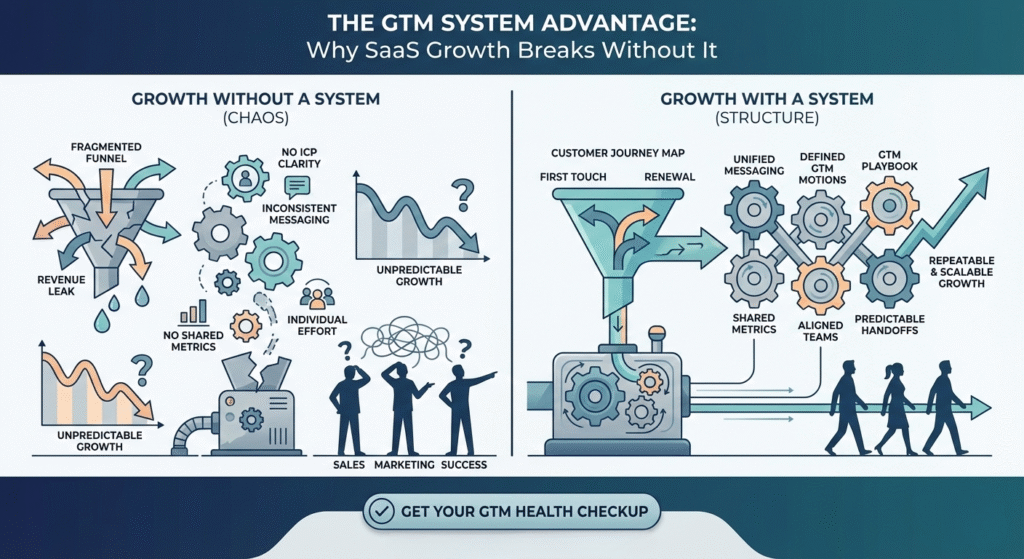
Most SaaS companies believe they have a GTM strategy.
What they actually have is a wishlist.
A few tactics.
A few templates.
A few tools stitched together.
But no system.
And that is exactly why growth feels unpredictable.
GTM is not a deck.
Not a campaign.
Not a collection of activities.
GTM is a system.
A system that tells teams how to plan, how to execute, how to measure, and how to grow.
Growth does not break overnight.
It breaks quietly when structure is missing.
Why SaaS Growth Breaks
SaaS growth usually breaks for simple and repeatable reasons.
• No clarity on ICP
• No unified messaging
• No consistent GTM motions
• No alignment between teams
• No predictable handoffs
• No shared metrics
When these gaps exist, revenue becomes a guessing game.
Sales pulls in one direction.
Marketing pulls in another.
Customer success reacts instead of leading.
Leaders make decisions with partial information.
Forecasts feel unreliable.
Performance swings from quarter to quarter.
The surprise is not that companies struggle.
The surprise is that they expect not to.
Growth without a system depends on individual effort.
And individual effort does not scale.
The GTM System Fix
A GTM system turns chaos into structure.
It replaces assumptions with clarity.
It replaces improvisation with design.
A strong GTM system creates alignment across the entire revenue organization.
It includes:
• A clearly defined ICP
• A unified value proposition
• Standardized GTM motions
• A shared operating model
• A strong GTM playbook
• One metric system
• One customer truth
Nothing fancy.
Nothing theoretical.
Just clarity that teams can execute against.
When teams know what to do, why they are doing it, and how to do it, execution becomes powerful.
Not louder.
Not busier.
Just effective.
It All Starts With the Customer Journey
High growth SaaS companies never guess the customer journey.
They map it.
Stage by stage.
Moment by moment.
From:
• First touch
• To evaluation
• To decision
• To onboarding
• To expansion
• To renewal
Once the journey is mapped, the GTM system becomes obvious.
Every motion attaches to a stage.
Every workflow supports a transition.
Every message aligns with buyer intent.
Every KPI measures progress.
This is why aligned teams move faster.
They are not improvising in real time.
They are following a deliberate design.
The Role of Messaging in the GTM System
Most SaaS messaging is vague.
Fluffy.
Generic.
Interchangeable.
A real GTM system forces clarity.
It answers the hard questions:
• What problem do we solve
• For whom
• Why us
• Why now
• What is the tangible value
When messaging is clear, pipeline quality improves.
When messaging is inconsistent, pipeline dies quietly.
Great GTM systems do not let each team interpret messaging differently.
They standardize it.
They reinforce it.
They operationalize it across channels.
The result is simple.
Consistent conversations.
Consistent expectations.
Consistent outcomes.
GTM Motions The Engine of the System
A strong GTM system defines the motions that drive growth.
Outbound.
Inbound.
Product led.
Partner driven.
But here is the difference between strong and weak companies.
Strong companies design motions.
Weak companies assume them.
High growth companies define:
• Who owns each motion
• What the motion looks like
• What triggers it
• What tools support it
• What success looks like
Weak companies run every motion at once.
Strong companies run the right motions with discipline.
Focus creates leverage.
Discipline creates scale.
The GTM Playbook Creates Repeatability
The best companies do not rely on vibes.
They rely on playbooks.
The GTM playbook becomes the blueprint for execution across teams.
It documents how the system actually runs.
A strong playbook covers:
• ICP guidelines
• Qualification rules
• Discovery flow
• Meeting structure
• Objection handling
• Handoff workflows
• Renewal plays
• Expansion plays
With a playbook in place, new hires ramp faster.
Managers coach with clarity.
Performance becomes measurable.
Execution becomes repeatable.
Growing without a playbook is luck.
Growing with one is a system.
Shared Metrics Keep the System Honest
A GTM system only works when metrics align.
If Sales tracks SQLs, Marketing tracks lead volume, and Customer Success tracks NPS, alignment breaks.
Everyone optimizes locally.
No one optimizes the system.
High growth companies share GTM metrics.
• Pipeline coverage
• Conversion rates
• Win rates
• Deal velocity
• Churn risk
• Retention rate
• Expansion rate
• GTM efficiency
One scorecard.
One truth.
One team.
Metrics turn opinions into decisions.
They expose leaks early.
They help teams fix problems before revenue suffers.
Why Systems Beat Effort at Scale
Effort drives early traction.
Systems drive sustainable growth.
As teams grow, complexity increases.
Without a GTM system, complexity creates drag.
With a GTM system, complexity becomes manageable.
This is the real advantage.
Not working harder.
Working with structure.
When GTM becomes a system, growth becomes repeatable.
Get your GTM health checkup
https://gtmplayroom.com/gtm-health-check-up/
Related Articles


Want to Apply These Insights?
Book a 45-minute GTM diagnostic and get a clear roadmap for your next 30-60-90 days.