

15 Buying Triggers SaaS Founders Must Use to Drive Revenue
Buyers don’t purchase because of features. They purchase because something fundamental shifts in their world. A trigger occurs. A moment arrives. A change happens that transforms their mindset from “maybe later” to “I need this now.”
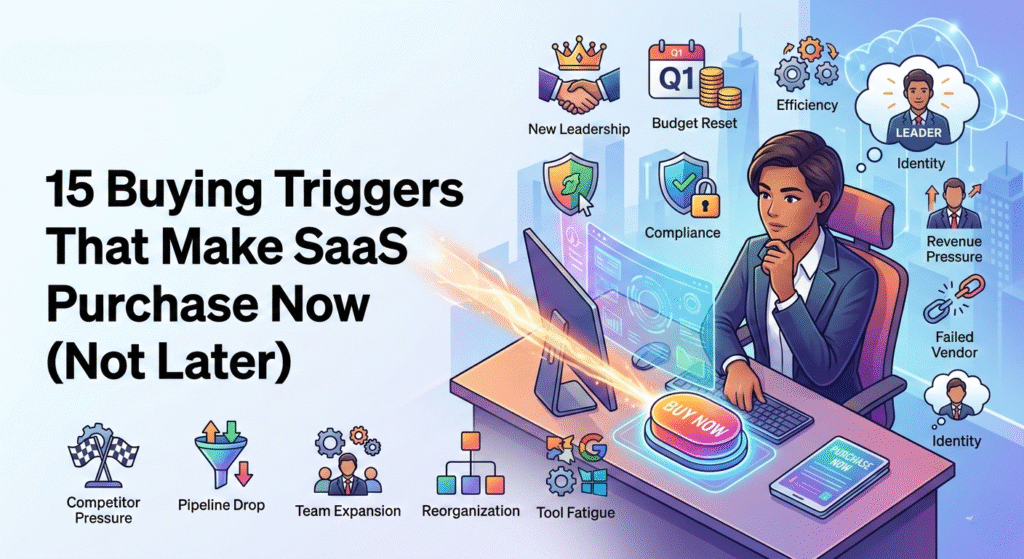
Most SaaS founders believe buyers make purchasing decisions because their product is superior, feature rich, or more affordable than competitors. This assumption couldn’t be further from the truth.
Understanding these buying triggers allows you to predict demand, craft compelling messaging, target the right ideal customer profile, and build a go to market engine that generates pipeline instead of constantly chasing it.
This guide reveals the 15 buying triggers every SaaS founder must leverage in 2026 to create consistent, predictable revenue.
Why Buying Triggers Matter More Than Product Features
Founders regularly ask themselves three frustrating questions. Why don’t buyers understand our value proposition? Why aren’t our outbound messages converting into meaningful conversations? Why are we consistently attracting the wrong ideal customer profile?
The answer is simple yet profound: your product isn’t aligned with the precise moment buyers experience their most acute pain.
Triggers solve this fundamental misalignment. They give you control over ICP definition, targeting precision, messaging resonance, channel strategy, qualification criteria, and pipeline predictability. Once you successfully map your buyer’s triggers, your go to market motion stops being random experimentation and starts becoming a repeatable, scalable system.
The 15 Psychological and Situational Triggers That Drive SaaS Purchases
1. New Leadership Trigger
When a new CTO, CMO, or CRO joins an organization, they’re motivated to demonstrate quick wins. New leaders purchase rapidly because they need immediate impact to justify their hire and establish credibility.
2. Budget Reset Trigger
The beginning of Q1 or Q3 brings fresh budgets and renewed purchasing power. Teams suddenly have allocated funds and genuine urgency to deploy those resources before the window closes.
3. Compliance Trigger
New regulations, unexpected security audits, or discovered compliance gaps create powerful purchasing momentum. When fear combines with urgency, you get immediate purchase decisions.
4. Pipeline Drop Trigger
When the sales pipeline shows concerning slowdown, leadership becomes hypersensitive to solutions. Any tool promising pipeline acceleration gains instant relevance and attention.
5. Efficiency Trigger
Teams feeling overwhelmed and overloaded actively seek automation to reduce their workload. This represents one of the strongest buying drivers heading into 2026 as organizations do more with less.
6. Competitor Pressure Trigger
Buyers respond quickly when competitors adopt innovative new tools or approaches. Nobody wants to fall behind in their market. Competitive fear drives surprisingly fast decision making.
7. Customer Churn Trigger
When churn metrics spike unexpectedly, teams scramble for solutions to plug the leaks. Customer success, customer experience, and revenue operations tools win significant deals during these moments.
8. Team Expansion Trigger
Hiring three to five new SDRs, account executives, or marketers creates immediate tool requirements. New teams need proper systems to onboard effectively and scale quickly.
9. Reorganization Trigger
Mergers, restructuring initiatives, or department shifts create chaos that demands new systems. Teams desperately need clarity, alignment, and tools during organizational transitions.
10. Tool Fatigue Trigger
Organizations drowning in too many disconnected tools desire consolidation. Any SaaS solution that credibly replaces three or more existing tools becomes an instant buy.
11. Revenue Pressure Trigger
When executives receive the dreaded “hit your number this quarter” mandate, urgency spikes dramatically. Desperation accelerates purchasing cycles significantly.
12. Failed Vendor Trigger
When a current vendor disappoints or underdelivers, your timing determines your win rate. Being present during vendor disappointment moments creates extraordinary opportunities.
13. Product Launch Trigger
Launching new offerings creates new workflows, which demand new tool requirements. Product launches trigger cascading needs throughout organizations.
14. Scaling Trigger
When teams reach 50, 100, or 250 employees, their existing processes invariably break down. They purchase tools specifically to regain structure and operational control.
15. Identity Trigger (The Most Underrated)
This psychological trigger deserves special attention. Buyers ultimately purchase based on who they aspire to become, not just what they need to accomplish.
They want to be recognized as a data driven leader. They want their team perceived as a modern go to market organization. They want to be known for running a predictable pipeline operation.
Identity consistently trumps logic in purchasing decisions. Always.
How Smart SaaS Founders Operationalize These Triggers
Target Moments, Not Just Industries
Stop targeting broad industries. Start targeting specific moments. Instead of “HRTech companies,” focus on “HRTech companies that recently hired a new VP of Sales.”
Craft Messaging Around Specific Triggers
Your messaging must speak directly to the exact trigger your prospect experiences. If they’re facing a pipeline drop, your message should be “Revenue feels unpredictable? Here’s how to achieve 60 days of pipeline consistency.”
Build Outbound Around Trigger Events
Outbound prospecting performs exponentially better when tied to observable events: new executive hires, funding announcements, job postings, public crises, or competitor announcements.
Qualify Leads Based on Trigger Presence
A lead only qualifies as high intent when an identifiable trigger exists. No trigger equals low conversion probability, regardless of other factors.
Position Your Product Around Maximum Pain Moments
Position your solution around the moment of maximum pain, which creates maximum urgency, which drives maximum conversion rates.
Buying Triggers Equal Predictable Pipeline
Once you successfully operationalize buying triggers throughout your go to market motion, three transformative outcomes occur. Your SDRs stop guessing and start targeting strategically. Your pipeline becomes genuinely predictable instead of hoping for the best. Your messaging suddenly clicks with prospects in a way it never did before.
Founders consistently believe they need better content, more sophisticated advertising, or higher performing salespeople. Most of the time, they simply need to align their entire go to market approach with fundamental buyer psychology.
Understanding and leveraging these 15 buying triggers transforms how you build pipeline, qualify opportunities, and close deals. The question isn’t whether these triggers affect your buyers. The question is whether you’re systematically identifying and targeting them before your competitors do.
Related Articles
Want to Apply These Insights?
Book a 45-minute GTM diagnostic and get a clear roadmap for your next 30-60-90 days.