

How High Growth Companies Build a GTM Strategy That Actually Works
It is the system that decides whether effort turns into revenue or disappears into noise.

Todays SaaS market is loud.
Crowded.
Brutal.
Buyers are overwhelmed with options.
Teams are stretched thin.
Every role is expected to impact revenue in some way.
In this environment, a GTM strategy is no longer a nice to have.
It is not a deck.
It is not a quarterly experiment.
It is the engine.
High growth companies understand this reality clearly.
They do not rely on gut feelings.
They do not chase every new channel.
They do not jump from idea to idea hoping something sticks.
They build a GTM engine that runs the same way every single day.
And that is why their pipeline stays steady while others panic.
That is why their teams execute with confidence instead of confusion.
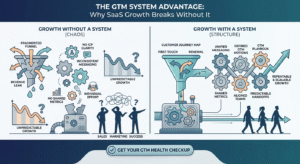
Predictable growth does not come from luck.
It comes from structure.
The Foundation of a Repeatable GTM Engine
Every repeatable GTM engine starts with one core principle.
The customer journey.
Not the founders intuition.
Not a viral playbook.
Not a tactic borrowed from another company.
High performing companies start by deeply understanding how their buyers think and behave.
They map every stage of the journey.
From first awareness to closed deal to long term retention.
They ask hard questions.
What problem does the buyer believe they have
What triggers action
What causes hesitation
What builds trust
What kills momentum
Only after this clarity do they build their GTM system.
Sales, marketing, and customer success are not treated as separate functions.
They operate as one system.
With one language.
One set of definitions.
One operating rhythm.
This foundation usually includes
Clear ideal customer profiles
A sharp and simple value proposition
A defined GTM motion
Clear growth opportunities tied to real demand
When this foundation is in place, something important happens.
Revenue becomes predictable.
Scaling becomes manageable.
Execution becomes smoother.
Teams stop guessing.
They stop reacting.
They start executing with intent.
Most companies skip this work because it feels slow.
High growth companies never do.
They know that speed without structure creates chaos.
Why GTM Readiness Matters Before Scaling
One of the most common mistakes teams make is scaling too early.
More sales reps.
More ad spend.
More tools.
More experiments.
But no readiness.
The result is predictable.
Pipeline looks full but does not convert.
Teams burn out.
Leaders argue about what is broken.
Revenue feels random.
This is where GTM readiness becomes critical.
A readiness assessment answers a simple but uncomfortable question.
Are we actually ready to scale.
It reveals whether the system can handle growth or whether growth will break it.
Readiness exposes
Whether messaging resonates
Whether the sales process is repeatable
Whether tools support execution
Whether teams are aligned
Whether the ideal customer profile is clear
Whether the GTM motion is consistent
These insights surface gaps early.
Before they turn into expensive mistakes.
High growth companies do not scale blindly.
They scale with confidence.
They scale because the system is ready.
They scale because the foundation is strong.
When readiness is high, growth feels controlled.
When readiness is low, growth feels painful.
The difference is not effort.
It is preparation.
The Power of a Real GTM Playbook
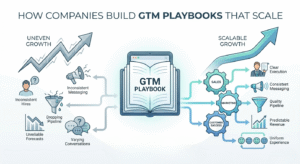
A GTM playbook is often misunderstood.
It is not a static document.
It is not a training deck stored in a folder.
It is the rulebook for how revenue is created.
A real playbook defines every critical moment in the customer journey.
First conversation
Discovery flow
Qualification criteria
Demo structure
Handoff process
Onboarding experience
Expansion signals
Nothing is left to chance.
Nothing depends on individual preference.
Nothing changes based on mood or personality.
When everyone follows the same playbook, consistency emerges.
Consistency leads to predictable outcomes.
Predictable outcomes lead to reliable forecasts.
Reliable forecasts lead to confident decisions.
Enablement becomes easier.
Coaching becomes sharper.
New hires ramp faster.
Customer experience improves across the board.
This is how companies scale without losing quality.
This is how teams grow without losing control.
A strong playbook is a long term growth asset.
It evolves with the market.
It improves with feedback.
It strengthens with every iteration.
High growth companies protect their playbook fiercely.
Because it is one of their biggest advantages.
GTM Alignment Removes Revenue Friction
Alignment is the oxygen of the GTM engine.
Without it, everything slows down.
Sales, marketing, and customer success must operate with shared intent.
They must agree on
Who the customer is
What problem is being solved
What success looks like
How progress is measured
When alignment is missing, friction appears immediately.
Pipeline quality drops.
Messaging becomes inconsistent.
Deals stall.
Retention weakens.
Customers feel confused.
Alignment eliminates these problems.
Shared goals create focus.
Shared metrics create accountability.
Shared definitions create clarity.
When alignment is strong, revenue flows smoother.
Deals move faster.
Handoffs improve.
Trust increases across teams.
Alignment is not a one time meeting.
It is not a document.
It is not a quarterly initiative.
It is a way of running the company.
High growth teams build alignment into their operating system.
Scaling Through GTM Performance Metrics
Instinct can guide early decisions.
But it cannot scale a business.
High growth companies treat GTM metrics like a heartbeat.
They monitor every motion.
They watch every signal.
They pay attention to velocity and drop off.
They constantly ask
What is working
What is slowing deals down
Where buyers disengage
Which channels convert best
Which motions deserve more investment
Metrics remove opinion from decision making.
They expose the truth.
They highlight where to improve.
They reveal what to repeat and what to stop.
When growth needs acceleration, metrics show exactly where to push.
High growth companies do not guess their next move.
The data guides them.
This discipline allows them to grow faster with less chaos.
To scale without losing control.
The Future Belongs to Companies With Integrated GTM Engines
The next decade of growth will not be won by larger teams.
It will be won by smarter systems.
The companies that succeed will have
Clear GTM motions
Strong alignment
Consistent execution
Tight playbooks
Accurate measurement
Fast decision making
Deep customer insight
A unified revenue engine
These companies will grow faster.
Stay efficient longer.
Adapt quicker.
Outlearn competitors.
They will not rely on hype or noise.
They will rely on systems that work.
A strong integrated GTM engine is the real competitive advantage.
Not tactics.
Not trends.
Not experiments.
The teams that build this engine today will dominate tomorrow.
Predictable.
Sustainable.
Coachable.
That is what real GTM looks like.
📩 Book your GTM Diagnostic → Here
Related Articles

Want to Apply These Insights?
Book a 45-minute GTM diagnostic and get a clear roadmap for your next 30-60-90 days.