

GTM Strategy vs Marketing vs Sales Plan: Stop Mixing These Up
Let’s clear up the most expensive confusion in early-stage companies.

Let’s clear up one of the most expensive, time-consuming, energy-draining confusions inside early-stage companies – the confusion between a GTM Strategy, a Marketing Strategy, and a Sales Plan. This confusion quietly burns months of founder effort, wastes budgets that cannot be wasted, and sends teams spinning in different directions while founders feel like they’re trying to hold the entire business together with sheer willpower.
Because here’s the truth:
Most founders don’t know which problem they’re actually trying to solve.
You’ll hear things like:
“We need GTM, let’s run ads.”
Or the classic “Pipeline is low, we need more SDRs.”
Or “Our messaging is weak, let’s redesign the website.”
And this is exactly like saying:
“We need to get fit, let’s buy shoes,”
or
“We need to get fit, let’s buy protein.”
Shoes matter. Protein matters.
But neither of them is the fitness plan.
Neither of them is the system.
Neither of them is the thing that gets you fit.
GTM works the same way.
Most startups try to fix symptoms, not the system.
Most early-stage teams try to upgrade one part of the engine while ignoring the architecture that keeps the entire engine running.
So let’s finally remove the confusion.
The REAL Difference (That 95% of Founders Don’t Know)
Here is the truth in its simplest, most founder-friendly form:
1. GTM Strategy = The Revenue Architecture (the system for how you win customers)
This is the blueprint.
The foundation.
The way your business acquires customers, repeats the acquisition, converts pipeline, captures expansion, and generates revenue consistently.
A GTM Strategy covers the entire revenue ecosystem:
- ICP (who you’re built for, who you shouldn’t chase)
- Positioning (how you fit into their world and why you matter)
- Messaging (the language your buyers respond to)
- Motions (sales-led, marketing-led, PLG, hybrid)
- Channels (where demand comes from)
- Pricing & packaging (how people buy)
- Revenue engine structure (pipeline architecture, handoffs, processes)
- Process + cadence (weekly rhythm, reviews, rituals)
- Metrics & dashboards (execution visibility)
Think of GTM Strategy as your Revenue Operating System. This is NOT marketing.
This is NOT sales.
This is the system that tells both of them how to work together.
2. Marketing Strategy = The Attention Engine (how you generate awareness & demand)
This is where most founders get pulled in first because it feels visible, creative, and immediate but marketing is only one part of the revenue machine.
Marketing covers:
- Content
- SEO
- Social media
- Paid ads
- Events
- Brand strategy
- Campaigns
- Email nurturing
- Website & landing pages
Marketing is powerful, but marketing without GTM is like shouting into a room without knowing who you’re talking to, what they care about, or why they should pay attention.
Marketing is not where revenue starts.
Marketing is where awareness starts. And the biggest mistake founders make?
Expecting marketing to fix problems that belong to ICP, messaging, or the pipeline architecture.
3. Sales Plan = The Conversion Engine (how leads turn into customers)
Marketing generates interest.
Sales converts interest into revenue.
But sales cannot convert consistently if the GTM Strategy is weak or the Marketing Strategy is attracting the wrong audience.
A Sales Plan includes:
- Playbooks
- SDR → AE workflows
- Qualification frameworks
- Pipeline stages
- CRM setup
- Process discipline
- Metrics, targets & forecasting
- Compensation structure
Sales is only as good as:
- the quality of leads (ICP accuracy),
- the strength of messaging (positioning),
- and the clarity of process (GTM architecture).
A great sales team with a broken GTM Strategy will always underperform, not because they’re bad, but because the system around them is broken.
Why Mixing These Three Up Breaks Everything
The short answer:
Because GTM is the architecture,
Marketing is the attraction,
Sales is the conversion.
And when you mix them up, you get chaos at every level.
Let’s make it brutally clear:
Great marketing → no pipeline
if your ICP is wrong or GTM motions are unclear.
Great sales → no inbound
if your marketing is misaligned or inconsistent.
Great content → wrong ICP
if positioning is weak or overly broad.
Great team → no structure
if pipeline architecture doesn’t exist.
Founder selling forever → no scalability
if GTM isn’t built to transfer founder intuition into a system.
Zero repeatability → random growth
because GTM is the repeatability engine, not marketing or sales.
So founders end up “fixing” the wrong things:
Pipeline low → “Let’s fix sales.”
Lead quality low → “Let’s fix marketing.”
Messaging unclear → “Let’s redesign the website.”
But none of these work in isolation.
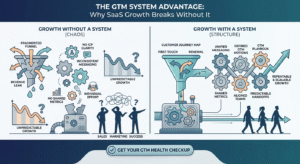
Because GTM is not a part.
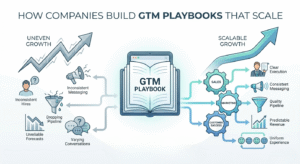
GTM is the system.Marketing and sales are tiny parts of the engine that the GTM Strategy controls.
When GTM is weak, no amount of marketing or sales will fix the revenue problem.
A Simple, Painfully Accurate Example
Imagine you’re building an HRTech SaaS product.
Your ICP is 100–500 employee mid-market companies.
But here’s what your execution looks like:
- Your marketing is attracting freelancers.
- Your SDRs are targeting enterprise CTOs.
- Your website messaging says “AI for everyone.”
Is this bad sales?
No.
Is this bad marketing?
Not really.
This is broken GTM Architecture.
Marketing is talking to one segment.
Sales is chasing another.
Your product positioning is pointing at a third.
And your ICP definition doesn’t match any of it.
That is not a marketing flaw.
That is not a sales flaw.
That is a GTM Strategy flaw.
Fixing sales will not fix this.
Fixing marketing will not fix this.
Fixing messaging alone will not fix this.You fix this by fixing the GTM Architecture so that every function points to the same place.
Why Founders Love GTM Diagnostics (and Why You Probably Need One Too)
Here’s the truth that every founder eventually faces:
You do not have the time, clarity, or detachment to diagnose your own GTM system.
You’re too close to the product.
Too close to the story.
Too close to the chaos.
That’s why a structured GTM Diagnostic is powerful.
In 45 minutes, you can uncover:
- What’s leaking revenue
- What’s misaligned between teams
- Where the architecture is broken
- Whether messaging is wrong or ICP is off
- What fixes will move revenue in the next 30–60 days
- How to move from founder-led chaos → to a predictable GTM system
And this is why founders (especially early-stage SaaS founders) walk out of the GTM Playroom Diagnostic saying:“I finally know what the real problem is.”
“I thought I had a marketing problem; I actually had a GTM problem.”
“This is what I needed 12 months ago.”
Want Us to Tell You Exactly What’s Broken?
If you’re tired of guessing which part of the business needs fixing — marketing, sales, messaging, ICP, pipeline, positioning, then stop treating symptoms and fix the system
📩 Book your GTM Diagnostic → Here
A predictable revenue engine is not built by accident.
It is built by architecture.
Let’s build yours.
Related Articles

Want to Apply These Insights?
Book a 45-minute GTM diagnostic and get a clear roadmap for your next 30-60-90 days.