

BDR vs SDR vs AE: Who Should You Hire First in Your SaaS Sales Team?
Whether you’re a first-time founder or a tech leader building your first go-to-market team, understanding the difference between BDR vs SDR vs AE is key to hiring smart.
Building a winning SaaS sales team starts with a simple but strategic question: Who should you hire first – an SDR, BDR, or AE?
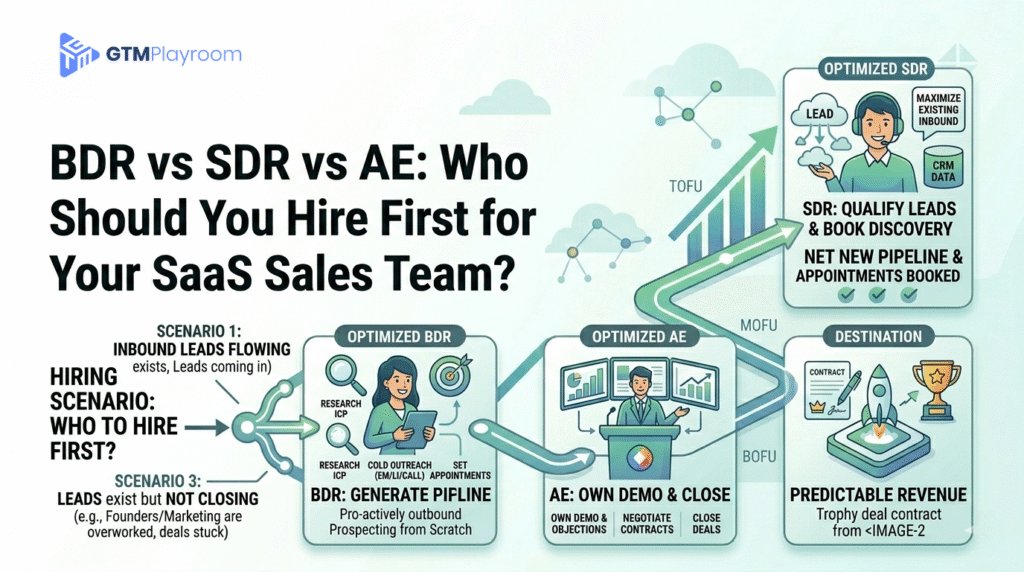
Each role plays a critical part in your sales funnel, but hiring them in the wrong order can create bottlenecks, wasted resources, and missed revenue. Whether you’re a first-time founder or a tech leader building your first go-to-market team, understanding the difference between BDR vs SDR vs AE is key to hiring smart.
Let’s break down the roles, compare their core tasks, and help you decide whether to hire SaaS SDRs, BDRs, or Account Executives first, depending on your business goals.
What Is the Difference Between BDRs, SDRs, and AEs?
At a glance, these titles can be confusing, especially since many tech companies use them interchangeably. But each role serves a distinct function within the sales pipeline.
- SDRs (Sales Development Representatives) focus on qualifying inbound leads or responding to marketing-generated demand.
- BDRs (Business Development Representatives) are more outbound-driven, targeting new prospects, running cold outreach, and creating net new pipeline.
- AEs (Account Executives) are the closers. They own the demo, negotiation, and contract stages of the sales cycle.
BDR vs SDR vs AE: Task Comparison
Here’s a simple side-by-side comparison of their day-to-day responsibilities:
| Role | Key Focus | Top Tasks | Stage of Sales Funnel | Best Time to Hire |
| SDR | Inbound/Outbound Prospecting | Respond to inbound leads, qualify prospects, book discovery calls, CRM data entry | Top of Funnel (TOFU) | Early stage with lead inflow but no qualification process |
| BDR | Outbound Lead Generation | Research target accounts, cold outreach (email, LinkedIn, calls), set appointments | Top of Funnel (TOFU) | When targeting new verticals or expanding outbound efforts |
| AE | Closing Deals | Run demo calls, handle objections, negotiate contracts, close deals | Mid to Bottom of Funnel (MOFU + BOFU) | When leads are qualified but no one is closing deals |
Deep Dive: Roles and Responsibilities
Sales Development Representative (SDR)
When to hire: You’re generating inbound leads via marketing, referrals, events, or signups, but need resources to follow up, qualify, or book meetings.
Core tasks:
- Contact inbound leads quickly and consistently
- Ask qualification questions using frameworks like BANT or MEDDIC
- Route SALs or SQLs to AEs
- Maintain accurate CRM records
Ideal for: Early-stage startups with a lean sales process who need to stop leads from falling through the cracks.
Goal: Maximize value from existing inbound demand.
Business Development Representative (BDR)
When to hire: You need to set up or expand your outbound engine to create a strong and active pipeline.
Core tasks:
- Research and identify relevant company accounts or personas (ICP)
- Personalize cold outreach campaigns across email, LinkedIn, and calls
- Nurture cold prospects and book first meetings for AEs
Ideal for: Startups expanding into new markets or segments without reliable inbound volume.
Goal: Generate top-of-funnel opportunities through proactive outbound.
Account Executive (AE)
When to hire: Your team is generating qualified leads via SDRs, BDRs, or founder-led sales, but no one is owning the closing process.
Core tasks:
- Conduct discovery calls and product demos
- Build relationships with stakeholders
- Navigate buying committees and handle objections
- Manage pricing, proposals, and contract signing
Ideal for: Teams that have a growing pipeline but lack consistent revenue conversion.
Goal: Close deals and drive revenue.
Who Should You Hire First: BDR vs SDR vs AE?
It depends on your current stage and lead generation model.
Scenario 1: You have marketing running and leads are coming in
Hire an SDR. Your first priority is making sure those leads are properly qualified, booked for meetings, and moved down the funnel. An SDR ensures you don’t waste hard-earned inbound traction.
Scenario 2: You have no consistent inbound pipeline and are ready to go outbound
Hire a BDR. A BDR builds pipeline from scratch, identifies high-value accounts, and helps you test outbound messaging.
Scenario 3: You (founder or marketing) are generating leads and doing demos yourself
Hire an AE. If you’re drowning in demos or deals are stuck because you can’t follow up consistently, bring in a dedicated AE. They’ll help you scale the close and own the full sales cycle from discovery to deal won.
Should You Combine the BDR and SDR Roles?
In the early days, hybrid roles can work. For example:
- SDR/BDR combo: One rep handles both inbound and outbound
- AE/SDR hybrid: A full-cycle rep who prospects and closes deals, also called an Inside Sales Representative
However, as you scale, role specialization increases efficiency and helps with performance tracking.
Final Thoughts: Build Strategically, Hire Smart
Hiring the right sales rep isn’t just about headcount. It’s about momentum. If you hire an AE without leads, they’ll sit idle. If you hire a BDR without a clear ICP or messaging, you’ll burn good effort. And if you generate great leads without an SDR, you’re leaking money.
By understanding the difference between BDR vs SDR vs AE, you can hire with clarity, build a solid sales foundation, and scale faster.
Looking to hire pre-vetted, job-ready SaaS sales talent? Explore SDR opportunities at GTM Playroom.
Related Articles



Want to Apply These Insights?
Book a 45-minute GTM diagnostic and get a clear roadmap for your next 30-60-90 days.