

From SDR to AE: What It Really Takes to Get Promoted in SaaS Sales
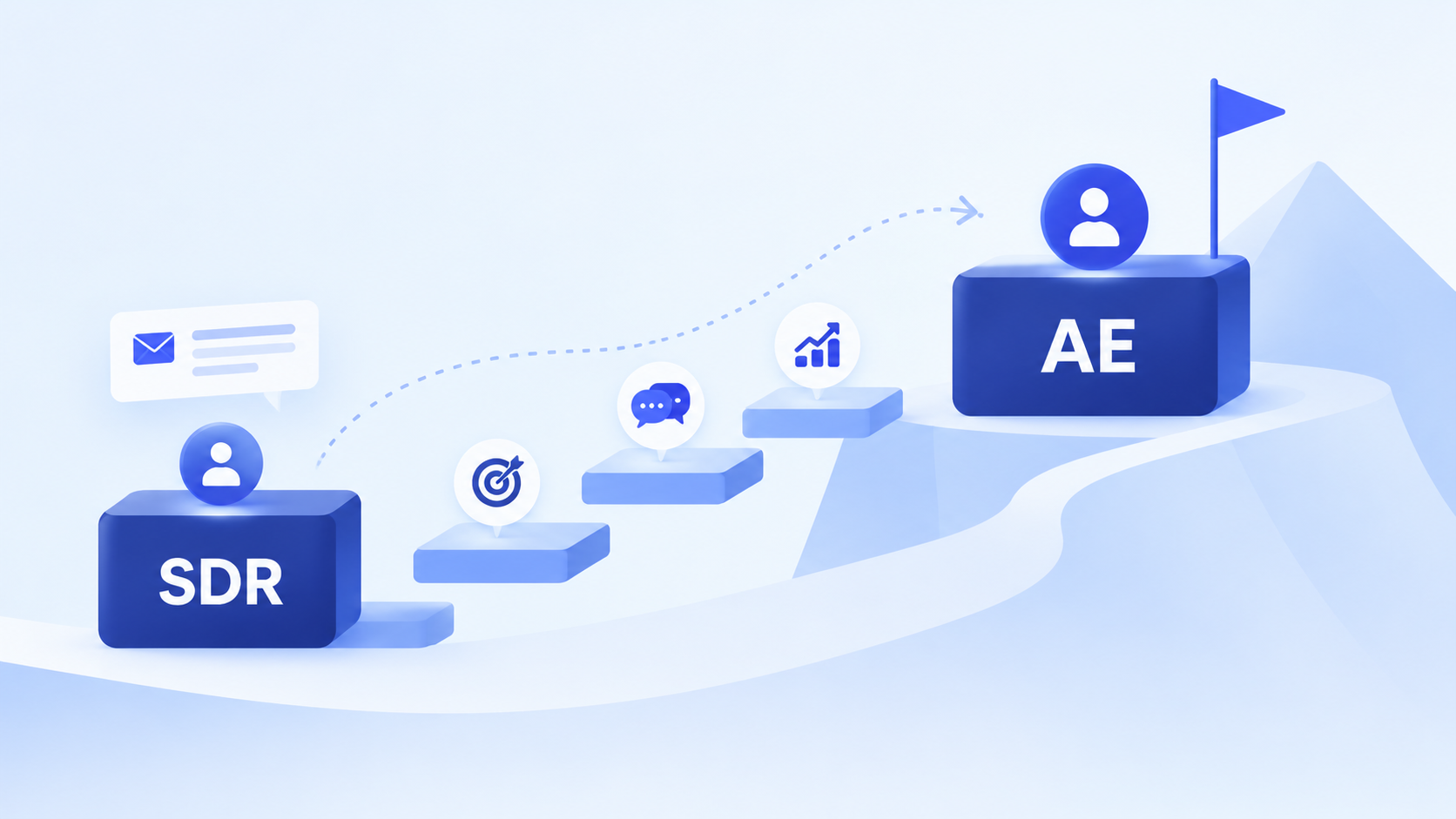
SDR to AE promotion, the move from Sales Development Representative (SDR) to Account Executive (AE), is a natural career goal for many sales professionals, but for a growing SaaS company, the decision involves much more than recognizing a strong performer. Promoting someone into a closing role means trusting them to manage customer conversations, qualify opportunities, navigate buying decisions and ultimately take responsibility for revenue.
The challenge for sales leaders is knowing when that trust is justified. An SDR may consistently generate qualified meetings, understand the product and build strong relationships with prospects, yet still need to develop the commercial judgment required to manage a deal from discovery to close. Treating these capabilities as interchangeable can leave both the employee and the business struggling to meet expectations.
A well-designed SDR-to-AE promotion process should therefore answer a more useful question than whether someone has earned a promotion: has this person demonstrated the skills, judgment and ownership required to succeed in the AE role?
For SaaS founders, sales leaders and talent teams, answering that question requires a clear understanding of the role, evidence of readiness and a consistent approach to evaluating internal talent.
For SDRs planning their next career move, our guide to the SaaS SDR career path from entry-level to Account Executive outlines the skills and development steps involved in making that transition.
Why SDR-to-AE Promotions Matter to Growing SaaS Companies
As a SaaS business grows, its sales organization must become more deliberate about how it develops people and allocates responsibility. The informal decisions that may work in a small founding team become harder to sustain when managers need to evaluate multiple candidates, build a predictable sales team and maintain consistent expectations.
Promoting an SDR can be a valuable way to develop internal talent, particularly when the person already understands the product, target customers and sales process. However, familiarity with the business does not automatically translate into the ability to close deals, and a promotion made without assessing the relevant skills can create difficulties for the employee and the team.
A mismatch may lead to additional coaching requirements, slower progress toward independent deal ownership, missed opportunities or a need to reconsider the role. These outcomes are not inevitable, but they are important risks to consider when deciding whether someone is ready.
The decision also affects the employee’s development. Clear expectations give ambitious SDRs a practical route toward becoming AEs, while vague promises of promotion can leave strong performers uncertain about what they need to demonstrate next.
For a growing SaaS company, the objective should be to create a promotion process that rewards genuine performance, identifies capability gaps and supports sound decisions about the future sales team.
SDR vs. AE: What Changes When Someone Moves Into a Closing Role?
The SDR and AE roles contribute to the same revenue process, but they carry different responsibilities. Understanding that distinction is essential because promotion readiness should be measured against the demands of the next role, not simply the achievements of the current one.
An SDR typically focuses on identifying potential customers, initiating conversations, qualifying interest and creating opportunities for the sales team. The role requires strong prospecting discipline, relevant messaging, effective questioning and an understanding of the company’s ideal customer profile.
An AE takes responsibility for progressing opportunities through the buying process. Depending on the company’s sales model, that can involve deeper discovery, product demonstrations, commercial discussions, stakeholder alignment, negotiation, forecasting and closing.
The difference is not simply that an AE has more conversations or attends more meetings. The role requires a different level of commercial ownership.
| Area | Sales Development Representative | Account Executive |
|---|---|---|
| Primary responsibility | Generate and qualify opportunities | Progress opportunities and close business |
| Customer conversations | Establish relevance and initial interest | Understand business needs and guide buying decisions |
| Qualification | Identify potential fit and buying signals | Validate the opportunity throughout the sales process |
| Commercial skills | Connect outreach to customer relevance | Connect product value to business outcomes |
| Opportunity ownership | Hand off qualified opportunities according to the sales process | Manage deal progression and next steps |
| Performance assessment | Activity, qualification quality and pipeline contribution | Revenue outcomes, deal progression and forecast quality |
Responsibilities vary by company, segment and sales motion, so this comparison should be adapted to the actual AE role being filled.
An SDR who excels at prospecting may already have several valuable skills for a closing position, including communication, persistence and customer awareness. The promotion decision should establish whether those strengths are accompanied by the capabilities needed to manage commercial conversations and take responsibility for progressing deals.
The exact division of responsibilities varies by company. For a closer look at how these roles differ, read our guide to BDR, SDR and AE responsibilities.
Why Hitting SDR Quota Is Not Enough to Prove AE Readiness
Quota attainment is important evidence of performance, but it should not be treated as a complete measure of readiness for a different job.
An SDR’s results can reflect a combination of personal execution and the environment in which they work. Lead quality, territory selection, brand awareness, product positioning, sales enablement and the effectiveness of the handoff process can all influence the opportunities an SDR generates. Looking at results without understanding these factors may produce an incomplete assessment.
Consider an SDR who consistently books meetings with relevant prospects and meets their targets. That performance demonstrates useful discipline and an ability to generate interest, but it does not necessarily show whether the person can conduct a detailed discovery conversation, handle commercial objections or manage several stakeholders through a buying decision.
Pipeline quality matters as well. A meeting is not automatically a qualified opportunity, and an opportunity that looks promising at the point of handoff may still lack a clear business problem, a credible buying process or sufficient urgency to progress.
Sales leaders should therefore examine performance alongside the behaviours that produced it. Call quality, qualification decisions, follow-up discipline and the ability to explain why an opportunity is worth pursuing can reveal more about readiness than a headline metric alone.
The aim is not to diminish SDR achievements. It is to recognize them accurately while evaluating the additional capabilities required for the next role.
The SDR-to-AE Readiness Framework: What Should Managers Evaluate?
A useful readiness framework translates the expectations of an AE role into observable behaviours. Rather than relying on confidence, tenure or a manager’s general impression, hiring and sales leaders can evaluate candidates against consistent criteria and record the evidence behind each decision.
Performance consistency and opportunity quality
The candidate should be able to explain their results, the quality of the opportunities they generate and the factors that influence their performance. Managers should look beyond a single successful period and consider whether the person’s results are supported by sound qualification and repeatable working habits.
Evidence might include opportunity reviews, call recordings, qualification notes and examples of how the candidate identifies prospects who genuinely fit the company’s ideal customer profile.
Discovery and qualification
Effective discovery requires more than asking a prepared list of questions. An AE must understand the customer’s situation, uncover the underlying business problem, explore its consequences and establish whether a credible reason to buy exists.
A candidate can demonstrate this capability through a structured role-play or a review of relevant customer conversations. The important question is whether they can respond to what the customer says, ask useful follow-up questions and distinguish surface-level interest from a meaningful business need.
Commercial judgment and value communication
A capable AE needs to explain why a solution matters to a particular customer rather than relying on product features alone. That means connecting capabilities to business priorities, recognizing when the proposed solution is not a strong fit and making reasoned decisions about which opportunities deserve attention.
Managers should look for evidence that the candidate understands the customer’s priorities and can explain the commercial value of a potential solution in language that makes sense to the buyer.
Objection handling
Concerns about price, timing, competing priorities and alternative solutions are part of commercial conversations. Readiness involves understanding the reason behind an objection, asking relevant questions and responding in a way that helps the buyer make an informed decision.
A candidate who simply memorizes rebuttals may struggle when a conversation moves away from a familiar script. Role-plays and observed customer interactions can help managers evaluate whether the person can think clearly and adapt their response to the situation.
Stakeholder management and buying processes
Sales opportunities can involve people with different priorities, levels of influence and concerns about making a decision. An AE needs to understand who is involved, what each stakeholder requires and what must happen before the opportunity can progress.
Candidates should be able to explain how they would identify relevant stakeholders, uncover potential obstacles and agree on meaningful next steps rather than assuming that one interested contact represents a completed buying process.
Deal ownership and execution
An AE must take responsibility for moving opportunities forward. This includes agreeing on next steps, following through on commitments, documenting important information and identifying risks before they become larger problems.
Managers can evaluate this capability by asking candidates to work through a hypothetical opportunity, explain how they would handle a stalled deal or review a scenario in which the buyer’s interest appears to be weakening.
Forecasting, accountability and coachability
Readiness also involves recognizing uncertainty and communicating it honestly. A candidate should be able to explain why an opportunity may close, what could prevent it from progressing and what evidence would change their assessment.
Coachability matters because moving into a new role involves learning. Managers should look for a willingness to engage with feedback, apply it to future conversations and take responsibility for improvement, rather than simply agreeing with whatever a manager says.
Fit with the actual AE role
Not every AE position requires the same capabilities. A role selling to small businesses may involve a different sales cycle and buying process from one serving enterprise accounts, while an inbound-led motion may demand different strengths from a heavily outbound role.
The readiness decision should reflect the actual position, including its customer segment, deal complexity, level of independence and expectations for commercial ownership. A candidate should not be judged against an abstract definition of an AE when the company needs someone for a specific sales environment.
How to Assess Whether an SDR Is Ready for an AE Role
Once the required capabilities are clear, managers need a consistent way to collect evidence. A structured process makes the decision easier to explain, helps candidates understand expectations and reduces the risk of promoting someone based mainly on personal preference.
Review performance in context. Examine results alongside the quality of opportunities, the sales environment and the candidate’s consistency over time. Performance data should inform the decision, not replace an assessment of the skills needed in the next role.
Observe real selling behaviours. Where appropriate and permitted, review recorded conversations, discovery calls, qualification notes and follow-up communication. These materials can reveal how a candidate listens, asks questions, interprets customer needs and handles uncertainty.
Use role-relevant work samples. A simulated discovery call, qualification exercise or deal review allows the candidate to demonstrate skills they may not yet have had the opportunity to use in their current position. The exercise should reflect the responsibilities of the actual AE role rather than test performance against an arbitrary scenario.
Collect structured feedback. Input from the SDR manager, AEs and other relevant colleagues can provide useful context, provided it is based on specific observations. General comments such as being a natural salesperson or having a great attitude should not carry the same weight as clear evidence of commercial capability.
Score candidates against defined criteria. A scorecard should record the capability being evaluated, the evidence collected, the assessor’s observations and any remaining development needs. Using the same criteria for candidates competing for the same role makes the process easier to apply consistently.
Here is a practical starting point for a promotion assessment:
| Capability | Evidence to review | Assessment approach |
|---|---|---|
| Opportunity quality | Qualification notes and handoff quality | Review real opportunities |
| Discovery | Questioning, listening and problem diagnosis | Structured role-play |
| Commercial judgment | Ability to connect value to business needs | Customer scenario |
| Objection handling | Response to concerns and follow-up questions | Simulated conversation |
| Deal ownership | Next-step planning and risk identification | Opportunity review |
| Coachability | Application of feedback | Repeat exercise after coaching |
This framework is a practical starting point, not a universal industry standard. Each company should define the behaviours that matter for its sales motion and refine the criteria based on evidence from its own hiring and promotion outcomes.
Should You Promote an SDR Internally or Hire an Experienced AE?
The decision to promote internally or recruit externally should begin with the needs of the role, the evidence available about the internal candidate and the time the business has to build the required sales capacity.
Internal promotion can be a strong option when an SDR has demonstrated the relevant capabilities, understands the company’s customers and sales process, and can take on the responsibilities of the role with an appropriate level of support. Existing product and customer knowledge may be useful, but it should complement evidence of readiness rather than substitute for it.
External recruitment becomes more relevant when the company needs experience that the internal team has not yet developed. This might include managing complex deals, selling into a particular market segment, handling a specific buying process or taking independent ownership of a sales motion that is new to the business.
The comparison should not be reduced to which option appears cheaper or faster. Leaders need to consider the capabilities required, development needs, recruiting and onboarding effort, expected time to productivity and the commercial consequences of leaving the role unfilled.
| Business situation | Potential course of action |
|---|---|
| An internal candidate has demonstrated the required capabilities | Consider promoting the candidate into the role |
| The candidate shows potential but has identifiable skill gaps | Set a development plan with clear milestones and a review date |
| The role requires experience that the internal candidate has not demonstrated | Consider recruiting an experienced external AE |
| The company needs additional sales capacity while developing internal talent | Assess external candidates alongside a structured internal development plan |
There is also a middle ground between immediate promotion and external hiring. When a candidate has clear strengths but still needs to demonstrate specific capabilities, a time-bound development plan can create a fair opportunity to close those gaps. The plan should state what the person needs to demonstrate, what support they will receive and when the decision will be reviewed.
An internal candidate should not be kept waiting indefinitely on the promise of a future promotion, just as an external candidate should not be selected simply because their previous job title suggests readiness. Both decisions deserve a role-specific assessment.
How to Build a Repeatable SDR-to-AE Promotion Process
A consistent promotion process helps a company develop talent without making every decision from scratch. It also gives SDRs a clearer understanding of what progression requires and gives managers a shared basis for evaluating candidates.
Define the AE role before evaluating people. Document the responsibilities, customer segment, selling motion, expected level of independence and core competencies required. Without a clear definition of success, managers may assess candidates against different expectations.
Make the criteria transparent. Explain what evidence will be considered, how candidates will be assessed and who will make the final decision. Clear expectations allow SDRs to focus their development on meaningful capabilities rather than guessing what their manager wants to see.
Connect development to observable gaps. Coaching should address the specific skills the candidate needs to improve, whether that involves discovery, qualification, commercial communication or deal management. Shadowing, role-play, supervised customer conversations and structured feedback can help build those capabilities.
Set review points and document decisions. Managers should agree on when progress will be reviewed and record the evidence supporting the outcome. If a candidate is not ready, the feedback should explain which requirements remain unmet and what improvement would look like.
Review what happens after promotion. Once an SDR moves into an AE role, evaluate their development against the expectations established for that position. Reviewing performance and coaching needs over time can help the business understand whether its assessment process is identifying the right capabilities and where the criteria may need refinement.
A repeatable process does not mean every candidate follows an identical path. It means that the decision is based on clear expectations and relevant evidence, with enough flexibility to account for differences in experience and the requirements of the role.
What SDR-to-AE Promotion Means for SaaS Sales Hiring
Internal promotion and external recruitment should not be treated as competing strategies. A growing SaaS business needs a clear view of the capabilities it already has, the people it can develop and the skills it must bring into the organization.
The same principle applies when hiring externally. A candidate’s previous title, quota history and years of experience can help establish context, but the selection process should still test whether they can perform the work required by the role.
That starts with defining the company’s ideal customer profile, sales motion, target segment and expectations for the position. A business hiring an AE to manage complex buying processes should assess those capabilities directly rather than assuming that success in a different sales environment will automatically transfer.
For companies building or expanding their sales teams, specialist hiring support can help bring greater structure to role definition, candidate evaluation and talent matching. GTM Playroom’s Sales & GTM Hiring service supports businesses hiring across SaaS and IT sales roles, including SDRs and AEs, with an approach that considers the company’s sales requirements and candidate fit.
The objective is not simply to fill an open position. It is to identify someone whose capabilities match the work the business needs done, while giving internal talent a fair and transparent route to progression.
FAQ
Frequently Asked Questions About SDR-to-AE Promotion
How long does it take to get promoted from SDR to AE?
There is no single timeline that applies to every company or candidate. Progression depends on the person’s demonstrated capabilities, the complexity of the AE role, the quality of available coaching and whether a suitable position is open. Rather than using tenure as the sole criterion, managers should define the skills required and assess whether the candidate has demonstrated them.
What metrics matter when promoting an SDR to AE?
SDR quota attainment, qualified pipeline contribution and opportunity quality can help establish performance in the current role. However, managers should also assess discovery, qualification, commercial judgment, objection handling and the ability to manage deal progression. The appropriate measures depend on the company’s sales motion and the responsibilities of the AE position.
Is hitting SDR quota enough to get promoted?
No. Meeting quota is valuable evidence of SDR performance, but it does not independently establish readiness to own deals. A promotion decision should also consider the candidate’s ability to understand customer needs, evaluate opportunities, handle commercial conversations and take responsibility for progressing a deal.
What skills does an SDR need before becoming an AE?
An aspiring AE should develop discovery, qualification, value communication, objection handling, stakeholder management, deal planning and forecasting skills. The relative importance of each capability depends on the role, so candidates should focus on the expectations of the AE position they want to enter.
Should a SaaS company promote an SDR or hire an experienced AE?
The right decision depends on the capabilities the business needs and the evidence available about internal candidates. Internal promotion can work when a candidate has demonstrated readiness, while external hiring may be necessary when the role requires experience or expertise that the current team cannot yet provide. A structured assessment helps leaders compare the options more consistently.
How can a manager assess whether an SDR is ready for an AE role?
Managers can combine performance reviews with observed customer conversations, structured role-plays, opportunity reviews and a competency-based scorecard. The assessment should use clear criteria tied to the actual role and record the evidence behind the decision.
Can an SDR become an AE without closing experience?
Potentially, depending on the role and the candidate’s demonstrated capabilities. An SDR may be able to show relevant commercial skills through structured exercises, supervised customer conversations and evidence of sound judgment. However, a position requiring established closing experience may call for a different level of demonstrated readiness.
What should an SDR do if there is no internal promotion opportunity?
The employee should discuss the requirements for progression with their manager, ask for specific feedback and agree on a development plan where possible. If there is no suitable role or a realistic path forward, exploring external AE opportunities may be appropriate, provided the candidate can demonstrate the capabilities required by those positions.
When should a SaaS company hire an external account executive?
External hiring is worth considering when the business needs capabilities that are not available internally, requires experience in a particular sales segment or needs someone who can take on the responsibilities of the role with an appropriate level of independence. The hiring criteria should be based on the actual requirements of the position rather than job titles alone.
Conclusion: Make Promotion Decisions Based on Evidence
Promoting an SDR to AE should recognize genuine achievement while establishing that the person can take on a different set of responsibilities. Strong prospecting results matter, but the decision also requires evidence of commercial judgment, customer discovery, opportunity management and readiness to own deal progression.
For SaaS leaders, the most useful approach is to define the role clearly, assess candidates against observable capabilities and create a transparent process for development and promotion. When internal talent is not yet ready or the business needs skills it does not currently have, external recruitment can help address that gap.
A thoughtful SDR-to-AE promotion process does more than support an individual career move. It gives the company a clearer way to develop its sales team, make hiring decisions and match talent to the demands of its revenue strategy.
If your team is building or expanding its SaaS sales organization, explore GTM Playroom’s Sales & GTM Hiring service to learn how we support sales talent hiring aligned with your business and sales requirements.
Explore Sales & GTM HiringWant to Apply These Insights?
Book a 45-minute GTM diagnostic and get a clear roadmap for your next 30-60-90 days.