

AI Automation for D2C Brands: What Should You Automate First?
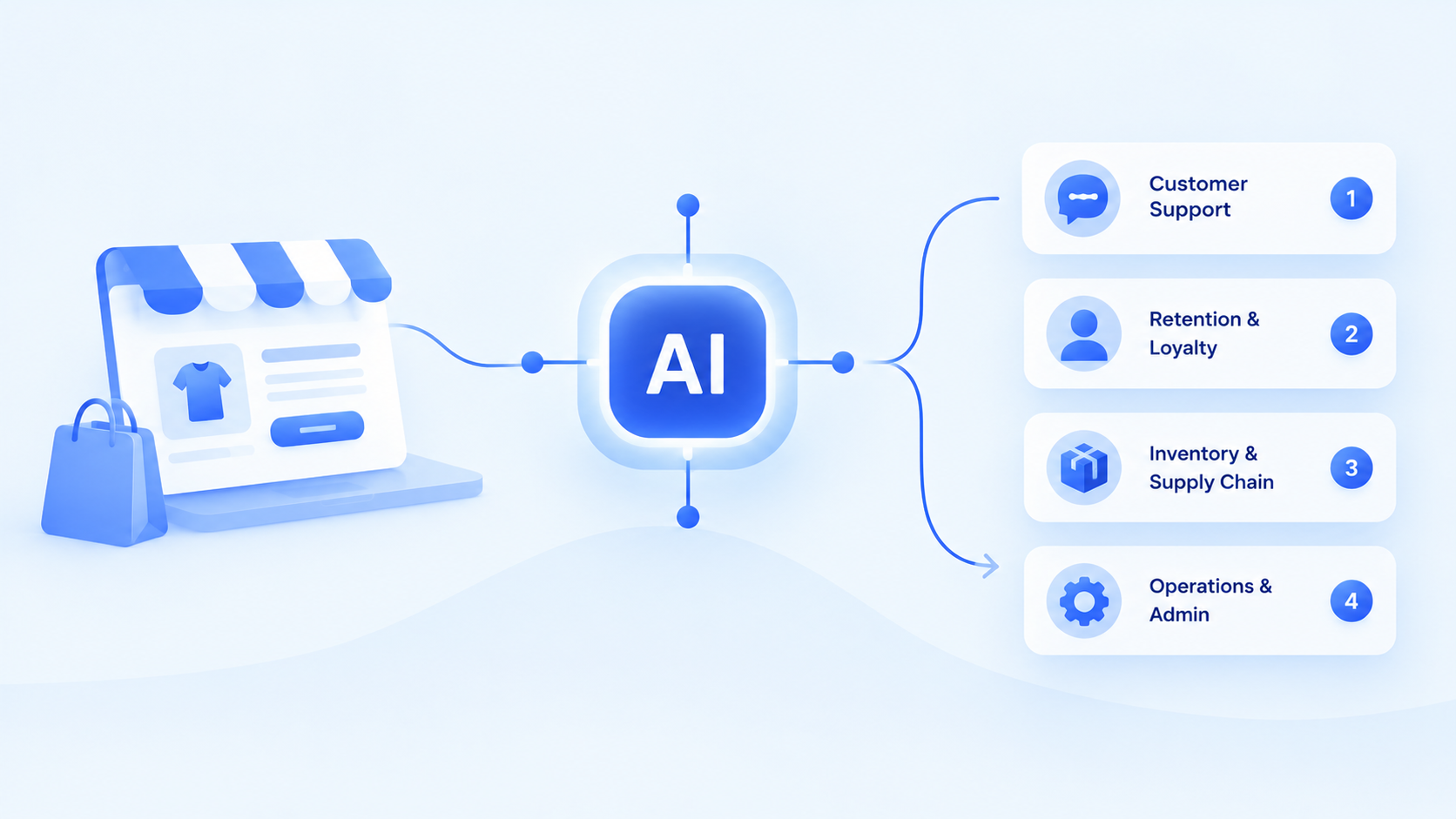
As a direct-to-consumer brand grows, the work behind every order becomes more complicated. Customer questions arrive across multiple channels, marketing teams manage increasingly detailed campaigns, operations teams coordinate stock and fulfilment, and leaders need a clearer view of what is driving revenue and where costs are building up.
Adding people and software can help, but neither automatically fixes a process that depends on repetitive manual work, disconnected systems or information that is difficult to access. This is where AI automation can make a practical difference, provided it is introduced to solve a specific business problem rather than simply to add another technology layer.
The important question for a D2C business is not whether it should use AI. It is which workflow should it automate first, and how will it know whether the investment is working?
For most brands, the best starting point is a high-volume, repetitive workflow with a measurable cost or revenue impact, reliable underlying data and a manageable level of implementation risk. Customer support, post-purchase communication, marketing operations, inventory planning and routine back-office work are all worth examining, but the right starting point depends on where the business is losing time, money or customer confidence today.
This guide explains how to assess those opportunities, choose the right first project, connect AI to existing systems and measure the results before expanding automation across the business.
Why D2C Operations Become Harder to Manage as a Brand Grows
Growth brings more customers, orders, products, campaigns and operational decisions. The difficulty is that these activities rarely sit neatly within a single system or team.
A customer may discover a product on Instagram, ask a question on WhatsApp, place an order through the website and contact support by email when the delivery is delayed. Meanwhile, marketing may be working in a campaign platform, customer service in a helpdesk, and operations in an order or inventory management system. Unless the relevant information moves reliably between these systems, employees end up checking records, copying details and resolving inconsistencies manually.
The same pattern appears across other functions. Marketing teams may spend time compiling reports instead of interpreting performance, while operations teams rely on spreadsheets to reconcile demand with stock availability. Customer service representatives repeatedly answer questions that could be resolved from approved order and product information.
These are not necessarily problems that require a complete technology overhaul. In many cases, the business already has the necessary systems, but the workflows connecting them are inefficient or incomplete.
AI automation can help connect those workflows by interpreting customer requests, extracting information from documents, classifying incoming messages, generating suitable responses and triggering actions within connected systems. Traditional automation can handle predictable steps, while AI is useful when the task involves language, context or less structured information.
The distinction matters because not every business process needs AI. A straightforward rule that sends an order confirmation after payment may be better handled by conventional automation. A customer asking whether a product suits a particular need may require language understanding, access to accurate product information and, in some cases, a human response.
The goal is to choose the simplest reliable approach that solves the actual problem.
How to Decide Which D2C Workflow to Automate First
Before comparing AI tools, map the work your teams perform repeatedly and identify where delays, errors or unnecessary effort occur. A workflow that looks impressive in a demonstration may have little commercial value if it addresses an infrequent task or depends on data the business cannot reliably provide.
Use the following criteria to assess potential projects.
1. Frequency and time spent
Start with work that occurs frequently and consumes meaningful employee time. Repeated order-status enquiries, manual report preparation, customer-message classification and transferring information between systems may be stronger candidates than an occasional task that already takes very little effort.
Look beyond the number of tasks completed. Estimate how much time each task consumes, how many people are involved and whether the work creates delays elsewhere in the process.
2. Financial and customer impact
Consider what happens when the workflow is slow, inaccurate or incomplete. Delayed responses may leave customers waiting, inconsistent inventory records may complicate fulfilment, and late follow-ups may weaken retention efforts.
The value of automation can come from reducing operating costs, avoiding rework, improving service quality or supporting additional revenue. Keep these outcomes separate when evaluating a project so that the business does not count the same benefit twice.
3. Data readiness
AI needs access to relevant, trustworthy information. A customer-support assistant cannot reliably explain a refund status if the underlying order record is unavailable, while a forecasting system will struggle if product identifiers, stock records or historical sales data are inconsistent.
Assess where the required information lives, who owns it, how frequently it changes and whether the automation can access it securely.
4. Integration effort and operational risk
A useful pilot should fit the business’s existing systems and approval processes as far as possible. Consider the complexity of connecting the workflow, the consequences of a wrong action and whether a person must approve sensitive decisions.
A system that drafts a response for review carries a different level of risk from one that issues refunds, changes prices or alters purchase orders automatically. The higher the consequences of an error, the stronger the controls should be.
5. Measurable success
Define the outcome before development begins. Depending on the workflow, this could mean reducing manual handling time, improving first-response time, lowering processing errors, increasing repeat purchases or improving forecast accuracy.
Record the current baseline, choose a suitable measurement period and agree on what would justify further investment. Without this step, a team may know that the automation is being used without knowing whether it is improving the business.
A practical prioritisation framework
Score each candidate against business impact, frequency, data readiness, implementation effort and risk. A simple impact-versus-effort matrix can help leaders compare options, but the score should support judgement rather than replace it.
| Opportunity | When it deserves priority | What to measure |
|---|---|---|
| Customer support automation | High volumes of repetitive questions across multiple channels | First-response time, resolution rate, escalation rate, customer satisfaction |
| Order and returns workflows | Frequent manual checks or status updates | Handling time, processing errors, repeat enquiries |
| Marketing and retention | Repetitive campaign operations and accessible customer data | Incremental revenue, repeat purchase rate, contribution margin |
| Inventory planning | Stock imbalances, unreliable forecasts or manual replenishment analysis | Forecast error, stockouts, excess inventory |
| Reporting and back-office work | Repeated data entry, reconciliation or report preparation | Time saved, error rate, exception volume |
These are starting points, not a universal ranking. A brand with a large support burden may benefit from customer-service automation first, while a business struggling with stock availability may gain more from improving demand planning.
The AI Automations D2C Brands Should Consider First
Once the most costly or inefficient workflows have been identified, the next step is to examine the specific tasks AI can handle and the systems it needs to access. The following opportunities cover customer-facing activities as well as the operational work that supports the customer experience.
1. Customer support across website, WhatsApp, email and social media
Customer support is often a sensible starting point when teams spend substantial time answering recurring questions about products, delivery, order status, returns and company policies.
An AI support assistant can interpret a customer’s message, retrieve approved information and draft or send an appropriate response through the channel where the conversation began. With the right integrations, it can check order details or provide a link to the relevant self-service process instead of asking the customer to repeat information already supplied elsewhere.
The important part is the connection between the conversation and the business systems behind it. A bot that can explain a general delivery policy but cannot access the customer’s actual order may still leave the support team doing most of the work.
A well-designed workflow should therefore include:
- Access to an approved knowledge base covering product information, policies and common questions.
- Secure access to the order or customer records required for the task.
- Clear rules for identifying uncertain requests and transferring them to a person.
- A way for the human support team to see the conversation history and actions already taken.
- Monitoring for incorrect responses, repeated failures and customer dissatisfaction.
The objective is not to force every conversation through automation. Product complaints, unusual delivery problems, sensitive requests and situations requiring judgement should reach the appropriate employee without unnecessary friction.
How to measure it: Track resolution rate, first-response time, escalation rate, customer satisfaction and the cost of handling a resolved conversation. A reduction in incoming tickets is not automatically a success if customers are abandoning conversations or returning with the same problem.
2. Order tracking, returns, refunds and post-purchase communication
After a purchase, customers want clear information about what happens next. Order confirmations, dispatch updates, delivery notifications, return instructions and refund-status enquiries can create considerable repetitive work when handled manually.
AI can interpret a customer’s question and route it through a workflow that retrieves the relevant information from the order management, shipping or returns system. Predictable updates can be handled through conventional automation, while AI can help when a customer asks a question in natural language or needs guidance on the correct process.
For example, a customer asking why a refund has not arrived should receive information based on the actual return and refund record, not a plausible-sounding estimate generated by a language model. If the record is missing or the case falls outside policy, the workflow should flag the issue rather than invent an answer.
Returns and refunds also require careful permission design. The system may explain a policy or prepare a request automatically, while final approval or payment-related action remains subject to defined business rules.
How to measure it: Monitor manual contacts per order, return-processing time, refund-status enquiries, processing errors and the time employees spend resolving exceptions.
3. Personalised marketing and customer retention
Marketing automation becomes more useful when it responds to what a customer has actually done, rather than sending the same message to everyone on a fixed schedule.
AI can help interpret browsing and purchase behaviour, identify relevant product categories, support customer segmentation and generate variations of campaign content. Connected to a marketing platform, these capabilities can support welcome journeys, abandoned-cart reminders, replenishment messages, product recommendations and win-back campaigns.
The business still needs to define the commercial logic. A replenishment reminder makes sense only when the product and expected usage pattern support it, while a discount should not be sent automatically to customers who would probably have purchased at full price. Consent, contact preferences, message frequency and the economics of each campaign must remain part of the workflow.
Personalisation should also be judged on more than clicks or attributed sales. A campaign may receive credit for a purchase that would have happened anyway, so leaders should compare results against an appropriate baseline or control group where feasible.
How to measure it: Evaluate incremental revenue, repeat purchase rate, conversion, unsubscribe rates and contribution margin. The strongest result is not simply more messages sent, but a better commercial outcome from relevant communication.
4. Demand forecasting and inventory planning
Inventory decisions influence cash flow, fulfilment and customer experience. Too much stock ties up capital and can create markdown pressure, while too little stock can leave demand unmet or force teams into costly last-minute decisions.
AI-based forecasting can analyse historical sales alongside relevant factors such as seasonality, promotions, product launches and supplier lead times. These forecasts can help operations teams compare expected demand with available inventory and identify products that may require attention.
Forecasting does not need to mean giving an AI system unrestricted control over purchasing. A practical first step is to generate recommendations and exception alerts for planners, who can review the assumptions and approve changes. Automated replenishment can be considered once the underlying data and decision rules have been validated.
Forecasts should also be evaluated at a useful level of detail. An overall forecast that looks accurate may conceal serious errors for a particular product, region or sales channel, especially when demand varies sharply across the catalogue.
How to measure it: Track forecast error, stockout frequency, excess inventory, inventory turnover and the amount of working capital tied up in stock. Compare performance with the existing planning process while accounting for promotions, supplier disruptions and other changes that affect demand.
5. Product discovery and purchase assistance
Customers may need help choosing between similar products, understanding specifications or finding an item that fits their needs. If the catalogue is complex, a conversational shopping assistant can help them narrow their options without requiring a long search through product pages.
The assistant should rely on structured product information, including attributes, availability, usage instructions and relevant restrictions. It can ask clarifying questions, compare suitable options and explain differences in plain language, but it should not invent features, make unsupported product claims or recommend an item simply because it is commercially attractive.
For categories where suitability affects safety, health or other sensitive decisions, the limits of automated recommendations need to be particularly clear. Human assistance may be necessary when a customer’s needs fall outside the information available to the system.
How to measure it: Examine product-discovery engagement, conversion rate, average order value and returns linked to incorrect expectations or poor product fit. A higher basket value is not a positive outcome if it comes with more complaints or returns.
6. Marketing operations, campaign reporting and content workflows
Marketing teams often spend time bringing data together, preparing performance summaries, adapting approved content for different channels and coordinating campaign assets. AI can assist with these tasks by summarising results, categorising feedback, producing first drafts and turning approved source material into channel-specific variations.
For reporting, the system should use clearly defined metrics from the relevant analytics and advertising platforms. It should distinguish recorded data from interpretation, show the period covered and flag missing information instead of presenting an incomplete view as a definitive result.
Content workflows need similar controls. AI-generated product descriptions, advertisements and campaign messages should be checked for factual accuracy, brand consistency, legal requirements and unsupported promises before publication. Human review is particularly important when content concerns pricing, product performance, ingredients or regulated claims.
How to measure it: Track report preparation time, content production time, revision rates, campaign testing velocity and the commercial performance of approved assets. Faster production matters only if quality and results remain acceptable.
7. Back-office processes and cross-system data handling
A growing D2C business may rely on employees to transfer information between ecommerce, finance, inventory, customer relationship and reporting systems. These tasks can appear minor individually, yet they create rework when information is entered incorrectly or exceptions go unnoticed.
Conventional workflow automation is often sufficient for predictable transfers and calculations. AI becomes useful when the process involves interpreting unstructured documents, extracting details from supplier communications, classifying unusual transactions or summarising information for review.
A sensible implementation keeps the distinction clear. Rules should validate fields and enforce business constraints, while AI can interpret ambiguous material or recommend the next action. Financial entries, supplier changes and other consequential operations should have approval controls appropriate to the risk.
How to measure it: Measure processing time, data-entry errors, reconciliation exceptions, rework and the time required to close outstanding items.
Not every D2C business needs all these automations at once. The best sequence follows the cost of the current problem, the readiness of the relevant data and the business’s ability to verify the result.
AI Automation vs Traditional Workflow Automation: What Is the Difference?
AI automation and traditional automation solve related but different problems. Traditional automation follows predefined instructions, making it suitable for predictable tasks with clear conditions and outcomes. AI can help interpret language, classify information, extract meaning from documents and make recommendations when the input is less structured.
A hybrid approach is often the most practical option for D2C operations.
Consider a customer who messages the brand to ask about a delayed order. AI can interpret the question and identify the relevant order, the order system can provide the current status, and a rule-based workflow can determine which updates are permitted. The response can then be generated using the verified information, with an exception routed to a human employee if the order data is incomplete or the case falls outside the approved process.
This design gives each component a clear responsibility. AI handles interpretation, business systems supply authoritative data, rules control permitted actions and people resolve cases requiring judgement.
Before investing in an AI model, ask whether a simpler workflow would achieve the same result. Adding AI to a process that already works reliably through ordinary automation may increase cost and complexity without creating meaningful value.
How to Integrate AI with Your Existing D2C Tech Stack
AI automation does not need to begin with replacing the systems a business already uses. In many cases, the more practical approach is to identify the systems that hold the required data and build a controlled workflow around them.
A typical D2C environment may include:
- Ecommerce platform: Product catalogue, cart, checkout and order creation.
- Customer relationship and customer data systems: Customer profiles, preferences and purchase history.
- Customer service and messaging platforms: Website chat, WhatsApp, email and social interactions.
- Order, inventory and fulfilment systems: Stock levels, shipment records, returns and delivery updates.
- Marketing and analytics platforms: Campaign activity, customer segments and performance reporting.
- Finance systems: Invoices, payments, refunds and reconciliation records.
The exact systems and available integrations vary by business, so technical feasibility should be checked before a project is approved. Data access, permissions, system limits and ongoing maintenance all affect the implementation.
What an integrated workflow looks like
Imagine a customer asks about an order through WhatsApp. The AI interprets the question and identifies the information required, the workflow verifies the customer’s identity where necessary, and the connected order system supplies the current status. A response is sent using that verified information, while any missing record or unusual exception is routed to the appropriate employee.
The customer does not need to understand the technology behind the exchange. The business, however, needs to know which system supplied the information, what the automation was permitted to do and what happens when the normal process fails.
Safeguards to put in place
A reliable integration should include:
- Authoritative data sources: Decide which system is the source of truth for orders, stock, refunds and product details.
- Access controls: Give each workflow only the permissions it needs to complete its task.
- Approved knowledge: Restrict customer-facing responses to verified policies, product information and relevant records.
- Human escalation: Define when the system should stop, request approval or transfer a case.
- Monitoring and logs: Record relevant actions and failures so that teams can investigate problems.
- Testing: Check ordinary requests, incomplete records, conflicting information, unusual cases and system outages before expanding access.
- Privacy and consent: Handle customer information according to applicable laws, platform requirements and the brand’s own policies.
Integration quality is not a secondary technical concern. It is what determines whether an AI system can perform useful work within the business rather than merely produce convincing text.
How to Measure the ROI of AI Automation in D2C
A business case should distinguish between time saved, costs avoided, service improvements and additional revenue. Combining all these benefits into a single optimistic estimate can make a project look more attractive than it really is.
Begin by measuring the existing workflow. Record the time employees spend on the task, the volume of work handled, the frequency of errors, the cost of rework and any relevant customer or commercial outcomes. After implementation, use the same definitions wherever possible so the comparison remains meaningful.
Next, account for the full cost of the new workflow. This may include development, integration, software usage, ongoing monitoring, maintenance, human review and the time required to manage exceptions. An automation that reduces one team’s workload but creates additional work elsewhere should be evaluated across the whole process.
Use the following formulas to structure the assessment:
ROI formulas
Net benefit = Measured benefits − Total costs
ROI = (Net benefit ÷ Total costs) × 100%
These formulas are useful only when the inputs are measured consistently. For example, if an employee spends less time handling repetitive enquiries, that time saving does not automatically equal a cash saving unless it reduces expenditure or is put to productive use. Similarly, sales attributed to an AI-assisted campaign should not all be treated as incremental revenue without considering what would have happened without the campaign.
Choose metrics that match the automation:
| Automation | Primary measures | Additional checks |
|---|---|---|
| Customer support | Resolution rate, handling cost, response time | Customer satisfaction, repeat contacts, escalation quality |
| Post-purchase workflows | Processing time, manual contacts per order | Refund accuracy, exception rate |
| Marketing and retention | Incremental revenue, contribution margin | Unsubscribes, discount cost, repeat purchase |
| Inventory planning | Forecast error, stockouts, excess stock | Supplier constraints, working capital |
| Product discovery | Conversion, recommendation engagement | Returns, complaints, product suitability |
| Back-office automation | Processing time, error rate, rework | Exceptions, auditability, downstream workload |
Set a baseline before launch, agree on the review period and investigate changes that could distort the comparison, such as seasonality, price changes, promotions or shifts in order volume. If the result is weaker than expected, determine whether the issue lies in the workflow design, the data, the integration or the original business assumption before expanding the project.
A Practical 30-60-90 Day Roadmap for D2C AI Automation
A phased plan gives the business a way to test an idea without committing to a broad transformation before the value is understood. The timeline below is a planning framework, not a promise that every implementation can be completed within these periods; complexity, data readiness and integration requirements will influence the actual schedule.
Days 1–30: Audit and prioritise
Map the workflows that consume significant employee time or create recurring customer and operational problems. Speak with the teams doing the work, review available process data and identify the systems that hold the information needed to improve it.
Select a focused pilot with a clear owner, a defined baseline and measurable success criteria. Confirm what the automation can access, which actions it may take, what needs human approval and how failures will be handled before development begins.
Days 31–60: Build, integrate and test
Connect the required systems and configure the workflow around the approved business rules. Test with realistic scenarios, including missing data, conflicting records, unusual customer requests and temporary system failures, rather than evaluating only straightforward examples.
Train the team on how the workflow operates, when to intervene and where to report issues. Start with controlled access or a limited set of cases where appropriate, then review the results before expanding the scope.
Days 61–90: Measure and improve
Compare the pilot’s performance with the original baseline, examine both the intended benefits and any new problems, and collect feedback from employees and customers where relevant. Correct weak points in the data, integration or workflow design, and determine whether the project should be expanded, redesigned or stopped.
If the pilot demonstrates sustained value, choose the next workflow using the same prioritisation process. Assign clear ownership for ongoing monitoring, system changes, policy updates and performance reviews so the automation remains useful as the business evolves.
Common Mistakes to Avoid When Automating D2C Operations
The most expensive mistakes often come from the way a project is selected and managed rather than from the AI model itself.
Automating a broken process: If responsibilities, approvals or data ownership are unclear, adding AI may make the existing confusion harder to trace. Fix the underlying process before automating it.
Choosing a use case because it looks impressive: A complex assistant may attract attention without addressing a meaningful business problem. Prioritise work with a clear cost, service or revenue impact.
Connecting AI to unreliable information: Outdated product details, inconsistent customer records and incorrect stock data can produce poor decisions even when the model interprets the request correctly. Establish data ownership and validation before relying on the output.
Giving the system too much authority: Customer communication, refunds, price changes and purchasing decisions carry different levels of risk. Match permissions and approval requirements to the consequences of an error.
Measuring activity instead of business value: Message volume, generated content and completed tasks show usage, not necessarily improvement. Track the outcomes the project was intended to change.
Ignoring employee experience: Teams need to understand what the automation handles, which decisions remain theirs and how exceptions reach them. Without clear responsibilities, automation can shift work rather than remove it.
Expanding before the pilot is proven: A workflow that works for one product category or customer segment may fail under different conditions. Confirm reliability and value before extending it across the business.
How GTM Playroom Helps D2C Brands Implement AI Automation
The value of AI automation comes from how well it fits the business workflow, the systems it connects and the result it is designed to improve. That is why the starting point should be a specific operational or commercial problem, not a predetermined tool.
Through its AI Studio, GTM Playroom presents AI solutions designed around business workflows, including a WhatsApp-based shopping experience for a D2C wellness brand. The page describes an increase in repeat orders within weeks of launch. This is a brand-specific example, not a guarantee that the same outcome will occur for every D2C business.
For a brand exploring automation, the practical first step is to identify where work is being delayed, repeated or handled manually, then assess whether AI, conventional automation or a combination of the two is the best fit. The implementation should account for existing systems, the availability of reliable data, the required safeguards and the metrics that will demonstrate whether the workflow is delivering value.
You can learn more about GTM Playroom’s approach to building AI for business problems on the GTM Playroom website.
Conclusion: Start With the Workflow That Costs Your D2C Business the Most
AI automation should not begin with a long list of tools or a plan to transform every department at once. It should begin with an honest assessment of where the business is spending unnecessary time, losing useful information, creating avoidable errors or making decisions without a reliable view of what is happening.
For some D2C brands, the best first project will be customer support connected to accurate order data. For others, it may be retention workflows, inventory planning or repetitive back-office processing. The right choice is the one that combines a meaningful business problem with accessible data, manageable implementation effort and a result the team can measure.
Once that first workflow is working reliably, the business can use what it learns to choose the next opportunity with greater confidence. Over time, this creates a more connected operating model in which AI handles suitable repetitive work, established systems maintain reliable records and employees retain control over decisions that require judgement.
Before choosing an AI tool, choose the workflow worth improving. That decision will shape the quality of the implementation and whether the investment delivers a result the business can actually see.
Have a D2C workflow you want to improve with AI? Explore GTM Playroom’s AI Studio to see how tailored AI solutions can address specific business needs.
Explore GTM Playroom’s AI StudioFAQ
Frequently Asked Questions
What is AI automation for D2C brands?
AI automation for D2C brands uses AI capabilities alongside business systems and workflow rules to handle tasks such as interpreting customer enquiries, personalising communications, analysing operational information and supporting decisions. The objective is to improve a defined process, not to replace every existing system or employee.
What should a D2C business automate first?
Start with a frequent, repetitive workflow that creates a measurable cost, service or revenue problem, has reliable data available and can be implemented with acceptable risk. Customer support, post-purchase communication, marketing operations, inventory planning and back-office data handling are all candidates, depending on the business’s actual bottlenecks.
Which D2C processes can be automated using AI?
Potential use cases include customer support, order-status enquiries, returns guidance, customer segmentation, retention campaigns, product discovery, demand forecasting, reporting, document processing and exception classification. Predictable steps may be better handled by conventional automation, while AI is useful for tasks involving language, unstructured information or contextual interpretation.
Can AI work with an existing ecommerce tech stack?
Yes, where the relevant platforms expose suitable integration methods and the required data can be accessed securely. Implementation feasibility depends on the specific ecommerce, customer service, order management, inventory, marketing and finance systems in use, along with their permissions and technical limitations.
What is the difference between AI automation and traditional automation?
Traditional automation follows predefined rules for predictable tasks, such as sending an order confirmation after payment. AI can interpret less structured information, classify messages, extract meaning from documents or generate responses. Many effective workflows combine both, using AI for interpretation and rules to validate information and control actions.
How can D2C brands measure the ROI of AI automation?
Measure the current workflow before implementation, then compare the results using consistent definitions. Account for implementation, integration, usage, maintenance and human-review costs, and separate actual cost savings from additional revenue or time made available for other work. Use a relevant baseline and avoid attributing every change in performance to the automation.
How can D2C brands automate customer support without losing the human touch?
Give AI access to verified product, policy and order information, define clear escalation rules and preserve the conversation context when a person takes over. Routine enquiries can be automated where appropriate, while complaints, sensitive cases and requests requiring judgement should reach a human team member.
What data should a D2C business prepare before implementing AI?
The requirements depend on the workflow, but may include accurate product information, order records, customer preferences, support knowledge, inventory history, campaign data or finance records. Teams should identify the authoritative source for each data type, address inconsistencies and establish access permissions before relying on AI-generated responses or recommendations.
How long does it take to implement AI automation in a D2C business?
The timeline depends on workflow complexity, data quality, system access, approvals and the level of testing required. A narrowly scoped workflow using accessible data may be simpler than an automation that spans multiple platforms or makes consequential decisions. A phased pilot helps the business validate feasibility and value before committing to broader implementation.
Should every D2C business automate all its workflows?
No. Automation should be selected according to business priorities, not the number of available use cases. A workflow should be automated when the expected improvement justifies the cost, complexity and risk, while processes requiring nuanced judgement or offering little measurable benefit may be better left unchanged.
Sources and further reading
- GTM Playroom: Overview of the business and its approach to AI solutions.
- GTM Playroom AI Studio: AI implementation examples, including a D2C WhatsApp shopping workflow.
- Salesforce: Direct-to-Consumer Guide: Background on D2C strategy, customer data, personalisation and operational considerations.
- BigCommerce: Ecommerce AI Automation: Overview of AI use cases in ecommerce, including customer experience, personalisation and operations.
- Valtech: The Era of Conversational Commerce: Research on conversational commerce and consumer willingness to purchase through AI-led chat experiences.
Want to Apply These Insights?
Book a 45-minute GTM diagnostic and get a clear roadmap for your next 30-60-90 days.